
Skip to content

Martin's Story of Chronic Brain Fog and Fatigue

Martin’s first email to me about his brain fog and fatigue started quite dramatically:

“I now have chronic brain fog and fatigue, but where to start……….I’m 58 now and up to my diagnosis of Coeliac Disease aged 8 I had chronic diarrhoea and stomach pain”

It’s fair to say he was setting the scene! But his health and wellbeing benefitted greatly from this early diagnostic and action:

It took the next 8 years to recover and improve. Through my teens, 20s and 30s I was very fit and active – walking, climbing and running.  I have Asperger’s Syndrome and when physically fit the impact of this was very mild.  But as my physical functioning, brain fog and fatigue has deteriorated, so the Asperger’s traits have become more pronounced.

Martin went on to describe (briefly) what occurred in the next few decades to his current situation:

I had a nasty back injury sustained at work in my mid-thirties over 20 years ago. Following time off work, a diagnosis of depression and medications my health felt like it was deteriorating. Its about 13 years since I was last in good health and I eventually had to quit my job.  

I experienced the beginning of a ‘Total Collapse’ about 9 years ago. I was in a completely zoned-out state. Intense physical pain and unable to function with chronic brain fog and fatigue. There have been 6 of these collapses since and each with it’s visit to Hospital and each with all the tests coming back normal!  The ups and downs have been a rollercoaster.  

The medics have put various labels on the situation. Which I do not think get to the nub of the issue at all. Diagnosed and treated for Depression (antidepressants and painkillers), Psoriatic Arthritis (NSAIDs), Rheumatoid Arthritis (Methotrexate, Tramadol, Naproxin, Morphine).

Still declining – I finally decided that none of this heavy medicine was improving my symptoms.  So I weaned myself off them all about a couple of years ago.”

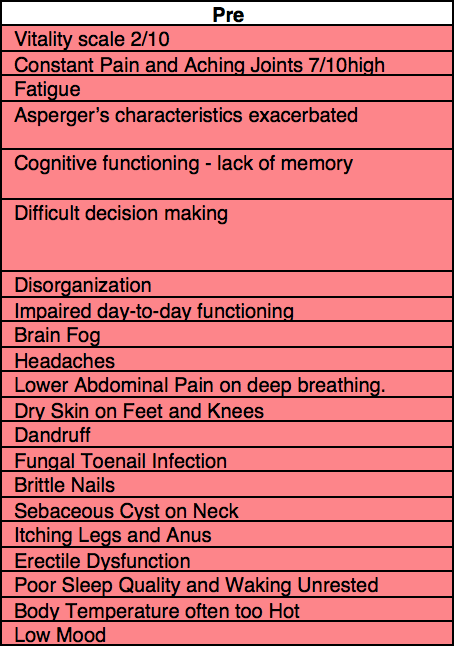
Here are all of Martin’s symptoms and health challenges he was experiencing when he contacted me.

PRE Symptoms
Brain Fog and Fatigue and Pre Symptoms

The Functional Health Clinic

Martin’s main health challenges were chronic brain fog and fatigue – but as you can see, he had many more throughout other areas, functions, systems, tissues, organs, glands, etc.  Such as a constant joint pain, lack of memory, headaches, dry skin, erectile dysfunction, itching legs, poor sleep and a low mood.

He also rated his vitality at only 2 / 10!

We want to achieve health goals as fast as is possible – but since I don’t have magic cures and quick fixes in my tool box – I explained to Martin that if we were to work together that we would need to be patient and give ourself the time to work through a process and infrastructure that would enable us to do two key things:

  1. Identify more factors that help him thrive – and increase them.
  2. Identify factors inhibiting his ability to thrive – and decrease them.

Quite a simple principle. But one that works when you stop guessing and start getting insight into how the body is functioning.

That’s why the first step of the Health Restoration Program is to collect comprehensive health history and timeline details.

Martin spent one whole Day in The Functional Health Clinic to run various assessments and discuss the way forward.

The Functional Health Clinic

Modalities to Solve Martin's Brain Fog and Fatigue

Martin worked with me for 6 months.  Let’s introduce the Modalities that he embraced to achieve some outstanding results:

BODYWORK

This does what it says on the tin.  Hands on bodywork that helps to integrate and align the structure and tissues of the body.  When we enhance the form, position, alignment, posture and tissue quality it creates an improved function.  We are working with the soft/connective tissues of the body – including fascia, muscles, skin, tendons and ligaments.

For example, we could create symmetry in the tension of the muscles on each side of the jaw bone (TMJ).  This can have a myriad of effects that reverberate through the body, from alleviating neck pain, headaches, digestive issues and even knee pain.  And perhaps brain fog and fatigue.

The causational relationships are of course very individual. And fascinating!

MOVEMENT

We are actually using movement in a similar way, for similar reasons as above.  Can we create movement programs that enhance the function of the body’s systems – Muscle-fascial-skeletal, Brain and Central Nervous System, Digestion, Detoxification, Cardio-Vascular and Lymphatics etc?

When people have chronic health challenges it is often the case that their relationship with exercise/movement is at one of the extremes.

1 – Too Much – Over-exercising, doing the same as they always have, in the fear of what will happen if they stop, even though it’s inhibiting progress.

2 – Too Little – Avoiding all forms of exercise due to any attempt so far exacerbating symptoms and challenges and unsure of how to utilise movement to help them towards their goals.

Thankfully there is always a point between the extremes that is conducive to success.

We’ll use various applications, methods and styles of exercise and movement as appropriate at the different stages of progress.  From Infant Movement Development to Strength and Conditioning.

NUTRITION

In short – we move between the confusion and contradiction.  Nutrition too is often applied and coached at extremes or right/wrong and good/bad.  If you aren’t embracing informed choice and individualising your approach to nutrition you’re choosing to play roulette!  It’s fatiguing to follow and bounce between one-size-fits-all – so we apply a wiser approach 🙂

FUNCTIONAL MEDICINE

The ability to be able to assess the function of these systems throughout our body (digestion, detoxification, immune, hormonal, etc) opens up vast potential for anyone searching for answers.  These systems have a blueprint of how to perform.  A Functional Lab Test has the capacity to help identify optimal function and dysfunction.

This is a huge piece of the puzzle when looking for insight from the body and avoids the pitfalls of guessing and chasing symptoms around the body.

…………………..

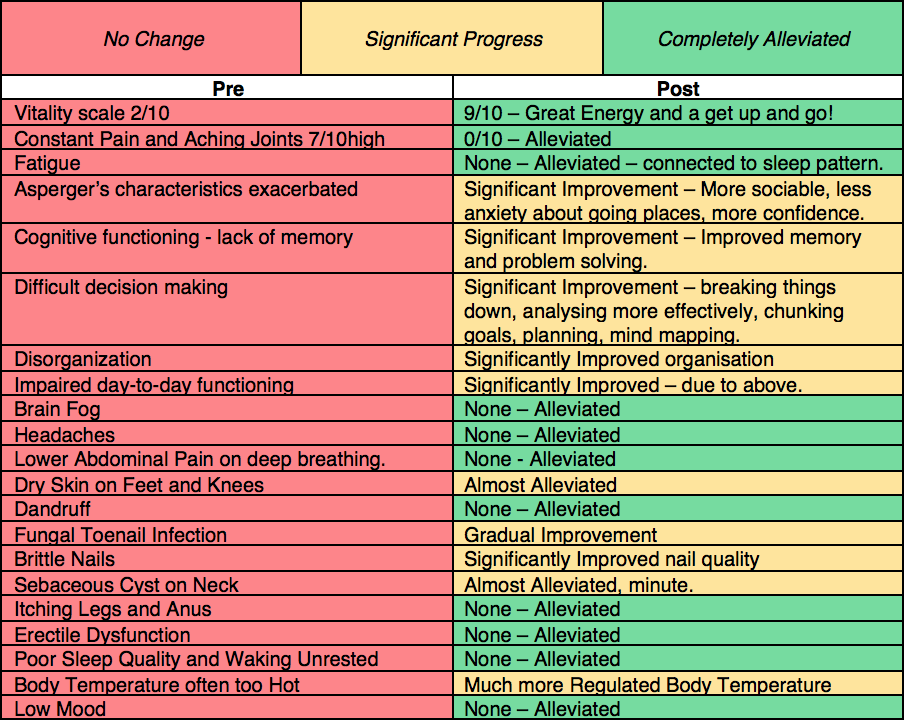
Let’s look at Martin’s POST Symptoms to see how these four modalities helped him.  Then we’ll delve into some more specific experiences he had and connections he made.

POST Symptoms (6 month Program)
Brain Fog and Fatigue Post Symptoms

How did he do it?: Stand-Out Moments

What did Martin do to achieve such great improvements in his wellbeing?  To go from a 2/10 to 9/10 Vitality surpassed his expectations. He completely alleviated both his Chronic Brain Fog and Fatigue.

Further elimination of major health challenges like chronic joint pain, headaches, lower abdominal pain, dandruff, itchy legs and anus, erectile dysfunction, poor sleep and low mood – illustrated the depth to which Martin had impacted his function.

Well – it wasn’t just ‘what’ he did, but ‘Why’ and ‘How’ he did it!

He didn’t just throw 101 strategies and remedies at the problem.  We didn’t just google the “Top 10 ways to solve x, y or z”!

We designed a way through.

It’s also important to note that of course – everything else that Martin was doing in all areas of his life (beyond these 4 modalities) was paramount 😉 – Home life, socialising, family, commitments, volunteering work, getting back to work and a whole range of behavioural factors.

The Initial Sinus Clear-out and Alleviated Brain Fog!

Would you believe that it took only one session of Bodywork (The Bowen Technique) to almost completely alleviate the Brain Fog, headaches and sense of pressure in his head?

The brain fog was a constant symptom of 13 years and in a single day there was a massive shift.

Here’s what happened…….. and according to Martin, it wasn’t a pretty sight!

When Martin came in to the clinic we assessed his structure and alignment with a specific test that is designed to identify the Primary Structural Stressor in the system. That which is connected to and impacting on the Central Nervous System.

This is great because there could be, let’s say, 10 ‘stressors’ in the body – yet we are fundamentally only interested in the priority one.  The 1 that has the greatest influence.

We don’t want to be distracted by the other 9!  We’d just be chasing symptoms without really resolving them and wondering why.

Especially when identifying and solving Number 1 will likely dissolve a few more along with it.  A reverberating ripple effect.  A much more satisfying and effective way to complete a 10-Point To-Do List!

Here’s the Short Version of what we did (then we’ll provide more technical insight for those interested):

The assessment showed that the primary stressor on Martin’s Central Nervous System was around his neck and head.  There was significant tension in the right side.  We targeted some bodywork moves to this area of muscles and connective tissues and reassessed to confirm whether we had released and resolved this first layer. Initially the assessment showed some encouraging changes – but the primary layer was not cleared yet.

We repeated some of the work to reduce the tension further and carried out more work around the Jaw (TMJ or TemporoMandibular Joint).

At this point – Martin remarked that he felt a significant sense of deep relaxation and described a “strange” sensation of the muscles around the back of his head and neck as they pulsated and gently tightened and relaxed. An involuntary squeezing and letting go….

This response continued for a few minutes and then we reassessed. This time we found that the primary dysfunction and asymmetry had been completely resolved.

Later that day Martin experienced the Sinus clear-out of all clear-outs!  Mucus, phlegm and goo – all moving to the exits. The throat and nose were flowing for a good few hours that evening and the next day.

…………When there was nothing left, Martin’s Brain Fog had almost completely disappeared.  For the first time in over a decade!  His headaches had resolved and so too the pressure he was feeling in his head.  Together with a new sense of improved clarity 🙂

Credit to Martin for his response to his response! He went with the flow (literally), supported himself through the challenge and came out the other side stronger.
Paranasal Sinuses Brain Fog

Longer – More Technical Version

For those who are as fascinated by this response as me – here is a look at some of the anatomy and physiology at play.

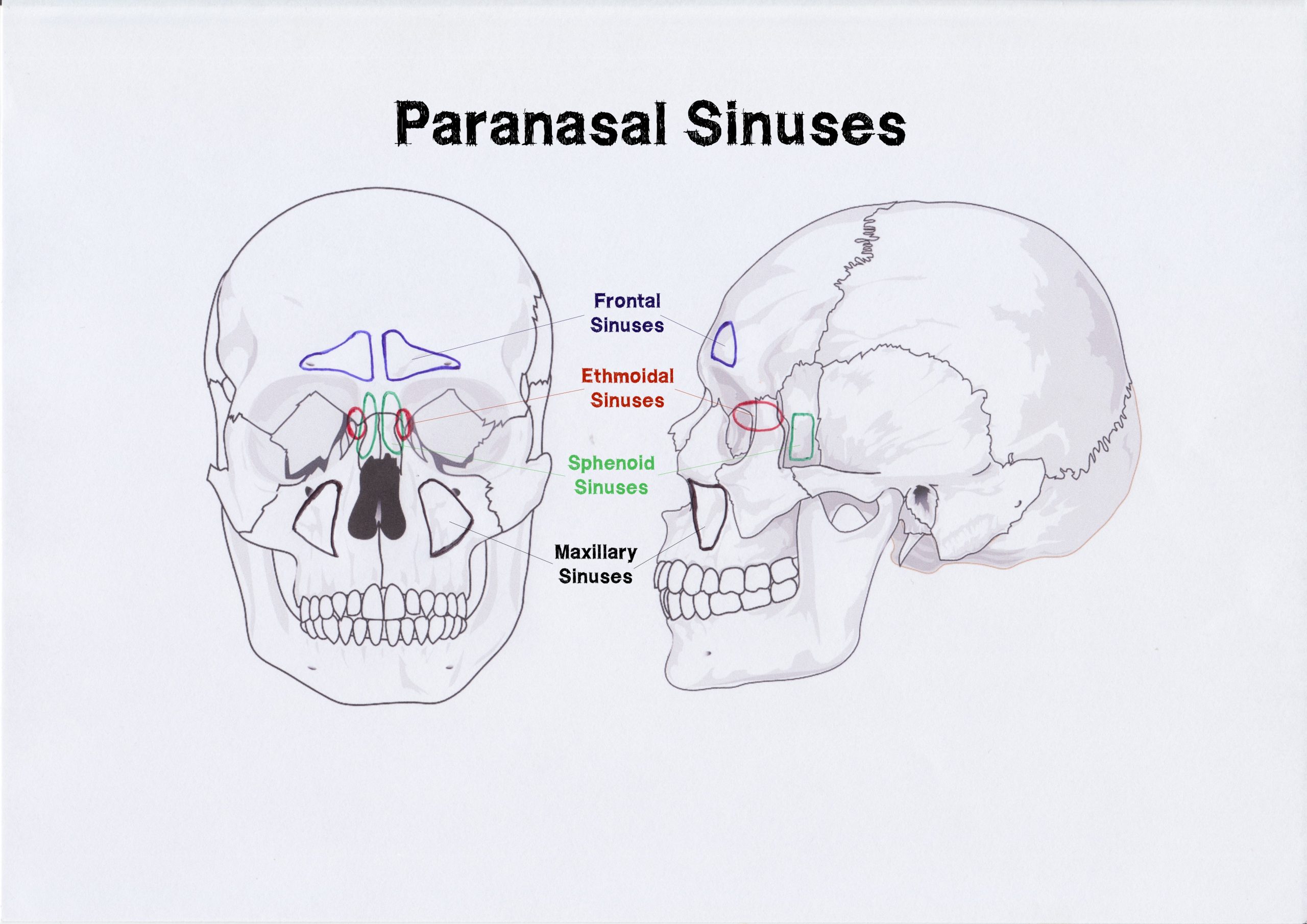
The above diagram illustrates the Paranasal Sinuses. There are 4 pairs of sinuses – the Frontal, Maxillary, Ethmoid and Sphenoid.  They are named after the cranial bones in which they are located.

One role of the sinuses is that as chambers they create a resonance and give each person’s voice an individual character.  Have you ever wondered why your voice changes when you are congested?

A sinus is a chamber. Air-filled cavities within these cranial bones.  Another role of the sinuses is to lighten the load and make the skull weigh less.

Ideally designed to be empty – each sinus cavity is covered by a mucosal lining, which will increase it’s production of mucus when having an inflammatory/immune response to something (bug, particle, chemical, toxin, etc).

Consider what happens to the overall weight of your head when there is a congestion, inflammation and build up of immune substances like mucus. There will typically be a sense of pressure, discomfort and heaviness.

In this Case Study we didn’t have images and scans of Martin’s sinuses.  We didn’t know what was lurking behind the scenes!  We just knew that he did not feel well, was struggling mentally and cognitively, couldn’t concentrate, felt inflamed, had pressure in his head and had brain fog and fatigue.

Here, we were following the clinical assessment.  Working with his body.  Not trying to guess that this was about to unfold.

Let’s look at where the sinuses live – the Cranial Bones.

Cranial Bones Brain Fog

It’s important to acknowledge that there are ‘joints’ between all of the different bones.  22 of the bones are more ‘fused’ together via sutures. The Jaw (Temporomandibular Joint) is hinged and allows significant movement.

Regardless – ALL of these joints and bones can move and change position.

There can be imbalances and asymmetries in their alignment and positions. This in turn can affect the other tissues, glands, vessels and organs that live in the spaces of the skull.  That’s a key reason why the Structural Integration work we did with Martin appeared to be so influential.

In particular – the Sphenoid, Mandible, Temporal and Occipital bones were crucial in regards to the Bowen moves we applied.

So, what influences these bones and gives the skull/cranium it’s structural integrity?

Cervical Cranial Muscles Brain Fog

The Connective Tissues: Muscles, Fascia, Tendons, Ligaments and Skin.

Anatomically there are lots of different muscles and tissues to label here.  So we’ll stick to discussing the ones that had most relevance in this Case Study on brain fog and fatigue.

Our clinical assessment (of Dural Drag) highlighted that the Primary Stressor on the Central Nervous System was from an attachment site(s) in the Cervical/Cranial (neck and head) region.

We carefully palpated the tissues to get a tactile picture and performed some Bowen moves. We worked on muscles like the Scalenes, Splenius capitis, Medial and Lateral Pterygoids and Occipitalis.

His natural head position when lying down on his back was with his head tilted to the right, yet this felt ‘normal and straight’ to him.  Martin had significant tension in two specific areas on the right side and we worked to release these.

To emphasise – we aren’t interested in just any tight muscle in the body.  There could be many of those!  These two were the droids muscles we were looking for!

The pulsing contraction and releasing that Martin experienced was a sign that these tissues (neuro-fascial-muscular) were changing their tension and relationship with the cranial bones. They were creating more structural integrity.  The cranial bones could then change their position, which in turn could potentially create a different space and environment for the sinuses.

It’s also interesting to note that the next day, Martin’s wife remarked to him that his “face looked different somehow!”

On Reassessment this layer of dysfunction was resolved.  This was just confirmation that the primary stressor had been removed.  It wasn’t a prediction that Martin would be sneezing and blowing his nose for the next 24hours 😉

It was confirmation that the bodywork had facilitated a change.  His function could therefore change and take care of the rest.

So after Day One's Successes - Was there anything else to do? Let's look through some more interesting aspects of Martin's Support.

The Cause of Pain - Is not (always) where you think it is

Throughout the Health Restoration Program we applied Nutrition, Functional Medicine and Movement – but whilst we are still on the topic of Structural Integration………

One Move Only

Sometimes it takes a whole session to resolve the primary dysfunction and sometimes it occurs really quickly.  On one of Martin’s appointments the goal was achieved in about 5 minutes.  The assessment targeted the Pelvis and Sacrum as the key area that was primarily structurally imbalanced.  There are a set of moves that we would usually sequentially work through in this case, but following one move on one side of the lower back (left Erector spinae), Martin started to feel a pulsating sensation in his sacrum.  This continued for a few minutes.

As a practitioner I have learned that sometimes (not always) less is more. This one move was enough stimulus and input to initiate a response from the body.  To do more moves (more stimulus) at this point would be unlikely to enhance the response. After a few minutes we retested and Martin was now in symmetry and had resolved that primary dysfunction.

Right Corrects Left, Lower Corrects Upper

The lesson that the body taught us on the sixth Bowen session was that there is no real separation of left and right or top and bottom.  A pain, restriction or dysfunction on one side of the body may originate on the opposite side.  Pain in the upper body may originate from the lower.

This may sound simple and obvious – but how many situations are there when the treatment for a left sided shoulder pain is only focussed on the left shoulder and left side?  How often is the treatment focussed only on where the pain is?

But what if that’s not how pain works?  Yes – Sometimes the cause of the pain is exactly where you feel it, it’s not cryptic.  Yet many times it may be elsewhere.  Ultimately you won’t fall into the trap of chasing pain if you simply use assessments that are designed to target the cause rather than the symptom.

In this particular session Martin had been experiencing left shoulder discomfort.  Specifically he felt pain and restriction when lifting his left arm out sideways and upwards (lateral abduction).  His left side range of motion was only 120degrees.

That day the assessment indicated to work on the lower dural attachments (lumbar, pelvic, hip).  Not the shoulder!  But as is often the case there was one particular muscle/connective tissue in this area that unlocked the restriction in his left shoulder.  But it was on the right side, not the left! It was in the lower body not the upper!

The right Adductor/Groin muscle (located on the inner thigh) was particularly thick, tender and tense. Once released, Martin’s whole (left and right) shoulder girdle started to gently contract and relax for a few minutes.  Martin was getting quite used to these types of responses now!

We reassessed the the left shoulder function and now Martin could lift his arm out from his side almost all the way up to the side of his head (now 170degrees) and completely pain-free!  All without touching his upper body, let-alone his left shoulder.

Coccyx Release and Knee Pain

The Coccyx is located at the very bottom of the spine (the ‘tail bone’) and it can be very influential with regards to pain and function on many levels.  If you’ve every ‘slipped and banged’ your coccyx you will know how tender and bruised it can be.  Yet – it can still be involved in dysfunction even if it does not ‘hurt’.

Assessing and identifying it’s involvement is fundamental if we want to get to the root cause of some presentations of pain and dysfunction.

One of Martin’s chronic joint pains of many years was left knee pain.  It would cause discomfort specifically on certain movements like walking upstairs and when squatting or lunging.

Even though the pain was in his left knee, during one appointment we identified a functional short right leg.  The coccyx was identified with asymmetry and greater tension on the tissues of the right sided attachments.  We released these tissues and this immediately corrected the leg length discrepancy, which had now become equal.

Improved postural balance and alignment is great – but this also proved to be the solution for the chronic left knee pain and enhanced movement.  Once again – no actual moves made anywhere near his left knee 😉

Join the Health Restoration Program

Scar Release on a 40-year-old Injury

Martin had a scar on the heel area of his right foot.  He had absolutely no pain in this area and no obvious link between it and any of his health challenges.

He hadn’t really given it much thought for approximately forty years, since he was 16 years old, when at the time he had an operation to have a heel spur removed.

Yet – we still saw the value of performing some very simple, non-invasive scar release work.

His response, whilst in no way life-changing, ora having much impact on brain fog and fatigue, was still quite fascinating.

Martin felt the scar at the beginning of the session and described it as non-painful and like there was a depressed ridge along the line of the scar, which you can see below.

It takes about 1-2 minutes to perform the the scar release technique and then we give the tissues a rest for a few minutes before repeating.  During the break Martin described that he felt something changing in his right ankle, which then started to move involuntarily! For about 60 seconds his ankle slowly and gently rotated, flexed, extended, turned in and turned out and Martin could feel some discomfort.

After a few minutes everything settled down.

Here are PRE and POST picture of his right heel, which had changed to a lighter colour and the ‘depressed ridge’ had now flattened too.

Every Scar Release gives a different response and just illustrates how influential scar tissue can be with regards to anything related to vascular, neurology, skin, pain, movement and more.

Movement with Fatigue in Mind

During the 6-month Program we also used Movement to solve these health challenges like brain fog and fatigue and most importantly – enhance vitality.

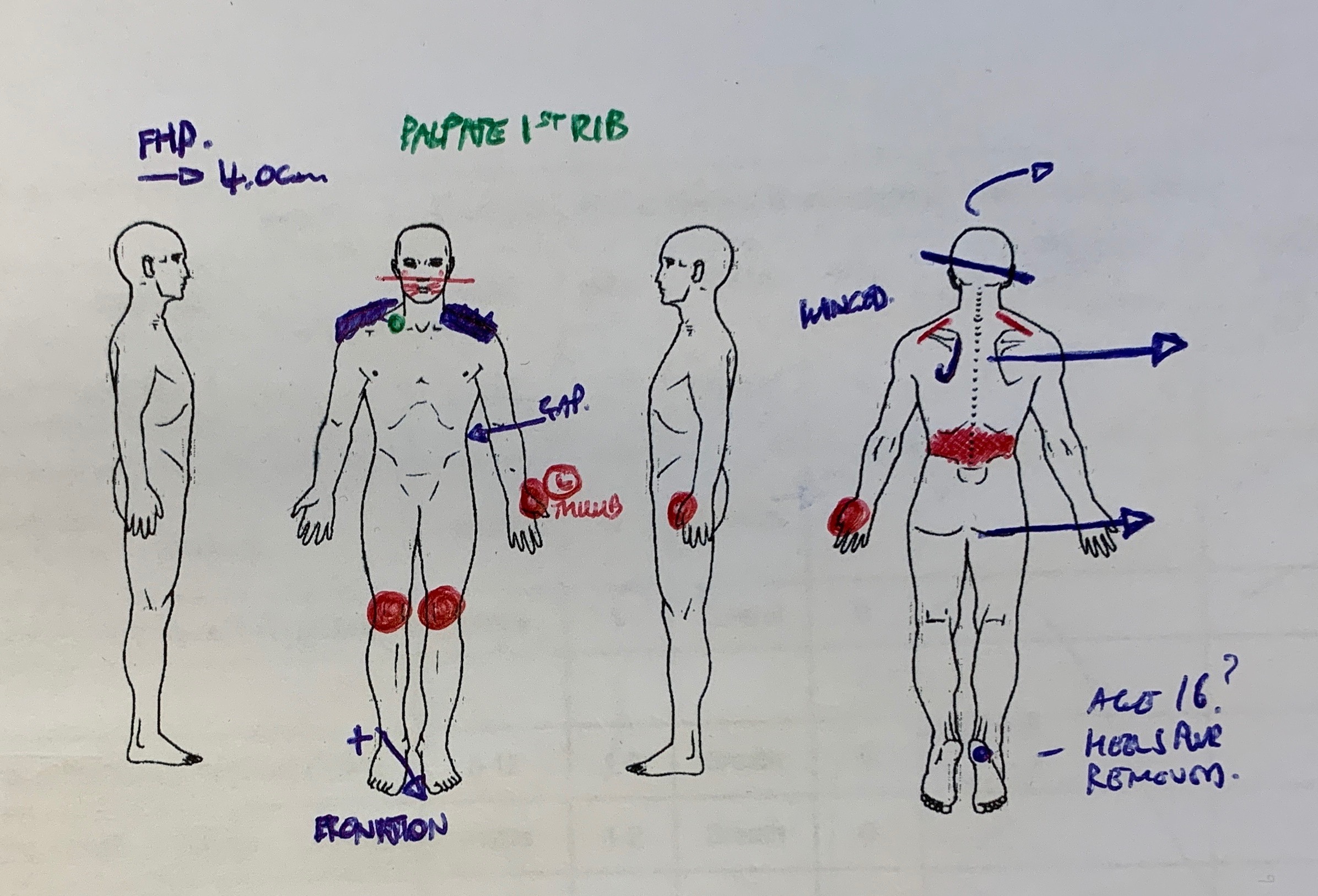
This will typically begin with an analysis of Physiological Load and many Postural and Movement Assessments.  We’ll take photo images and videos and note some observations of posture, body reading patterns, weight shifts, tilts, rotations, pronation, supination, head position and more.

We aren’t over-thinking this or comparing posture to the ‘Textbook’ version!

Simply observing to see what patterns and relationships are evident throughout the body.  Where is the pain, what may be the cause, is there a response or compensation pattern?  What will change?
Physical Assessment Fatigue

Breath-work for Fatigue

We will always assess the breathing mechanics.  It’s always important, not just when brain fog and fatigue are some of the main challenges.  Hierarchically it is a priority function for the body.  Which means that if anything represents a challenge to it the body will quickly compensate to preserve the quality of the breath.  In terms of ‘survival’ the body is perfectly ok with us having neck pain – if the postural compensation has supported our ability to breathe.  It would prefer great breathing and no pain of course…… But if it is forced to choose……

Furthermore – whenever the breath is compromised – the change in function is guaranteed to be having an impact on other systems, tissues, organs and functions.

When Martin took a deep breath in he experienced a pain in his lower abdominals.  He hadn’t felt this previously – because he hadn’t been breathing deeply…..for years.  His body most likely knew subconsciously about the discomfort and was avoiding pain by changing the way he breathed.

Consciously though, for success and progress, pain needn’t be avoided.  It needn’t be judged. You don’t have to fight or be versus it.

We spent time each week assessing and using various different breathing techniques and exercises to relatively quickly establish correct breathing mechanics and a full, deep breath with no pain.

With that established – Martin now had ~22,000 breaths per day working with and for him and contributed to him solving his chronic brain fog and fatigue I’m sure!

Length Tension, Movement Profiles and Postural Analysis

There are numerous other measurements and analyses we can perform in clinic too.  We often look at TMJ (jaw) and Cervical function, spinal curvatures and pelvic alignment, inner unit activation, muscle function and functional movement patterns.

This is really helpful when it comes to choosing exercises and designing programs.  The aim and purpose of this is fully individualise Martin’s program.  Not just to send him away and say do some ‘stretching’ exercises, ‘be more active’, do ‘thirty minutes a day’, etc…..

Applying and progressing through each targeted exercise and program enabled Martin to be continuously working on bringing his body back into balance.  Strengthening what was weak and taught, lengthening what was tight, creating symmetry and alignment, improving spinal curvatures, developing his functional movement patterns, increasing his thresholds and so on.

Cultivating not Fatiguing

When Martin first came to see me he was barely exercising because everything he tried to do would just wipe him out, aggravate his brain fog and fatigue or leave him in more physical pain.  Therefore, the over-arcing theme of the program over 6 months of Movement was that of ‘cultivating energy’.

This are sometimes referred to as a more ‘yin-like, energy, working-in’ approach.

Ultimately – the program is simply based on principles such as movement quality, alignment, breathing, pain-free, function, foundational, postural awareness, individualised and progressive.

We start simple, learn the thresholds of the body and then build its complexity with each phase.

Movement Program Fatigue

Was he Healing from the Inside-Out?

We designed 6 programs over 6 months. At each transition there were some very interesting responses from Martin’s body.  Not the usual muscular aches you might get when starting a new exercise program.

If it had happened once, we wouldn’t call it a pattern and attribute the Movement program to initiating such therapeutic effects for Martin.  Yet the pattern that emerged on progressing to a new program was quite evident.

Each new program was designed to build on the previous and find the balance of challenge to Martin’s strength, posture, movement and overall function.  It would take his body a few days to get used to the changes that were taking place.

Very interestingly, itching of his legs would increase and then begin to decrease once he got used to the exercises.  Chronic itching was an initial symptom and through the fluctuations over a few months he gradually reduced and alleviated this completely.

Similarly – at the beginning of new programs he would notice bruising coming out on his arms and legs (unrelated to contact, bumps, knocks etc).

This is something that we discussed and advised a Medical consult for, but Martin was also confident that he was “healing tissues from the inside out”. Again – he alleviated this completely by the end of his support.

During one program that included exercises to enhance form and function through his shoulder girdle and arms, Martins elbow began to swell up significantly. There was no impact trauma, cut, sting, bite, no loading or pressure during the exercise and it was not thought to be aggravating.  We don’t know what actually caused this.  His GP didn’t either.

It was as if every program and progression of exercises was getting deeper into the (t)issue.  Enhancing circulation and delivery of nutrients, improving lymphatics and waste removal, strengthening the immune system and the anti-inflammatory power.

It’s very difficult to specifically attribute the movement to these responses.  It may be that they are unrelated.  But the pattern was at least an interesting aspect to witness and observe.

Symptom-Free Gut versus Optimal Gut Function

Parasite_Dientamoeba fragilis fatigue

Many people contact me because they have obvious and chronic gut health and digestive health symptoms.  But as you can see from Martin’s list of symptoms (joint pain, lack of memory, headaches, dry skin, erectile dysfunction, poor sleep, low mood, brain fog and fatigue) this was not the case here.  However – we are using a Functional Health approach which considers all systems of the body.

That doesn’t mean it is appropriate or always realistic to assess all the systems and functions of the body, of course.

But given the timeline, health history and previous lack of comprehensive testing for the Gut we decided that this would be of value.  Martin was comfortable with running the test even if it meant he could ‘rule-out’ and focus elsewhere.

You can see part of his Digestive Health Test Results Report above and you can read more about this Functional Lab Test here.

We indentified an Opportunistic Parasite called Dientamoeba fragilis.

There is some disagreement about whether Dientamoeba fragilis is a serious threat to human health. The scientific literature certainly supports Dientamoeba fragilis as a causative factor in digestive symptoms, as does our clinical experience. Typical symptoms include bloating, gas, loose stools, diarrhea, abdominal tenderness, pain, cramping, fatigue, nausea, weight loss or gain. D. fragilis has been isolated from surgically removed appendices (after appendicitis), suggesting that the infection may be a cause of this problem too.

So there is no guarantee that this parasite is pathogenic in this instance, but it is an important finding for Martin to consider as he builds more pieces of the puzzle.

sIgA fatigue

Secretory IgA

Secretory IgA, or sIgA, is a class of antibodies produced by and secreted from mucosal surfaces, especially the GI and respiratory tracts. In the gastrointestinal epithelium, sIgA is the first line of defense against the entry of enteric toxins and pathogenic organisms from the colon. This could be a sign that it has been under a large workload and is running low on power, together with the fact that increased stress hormone production suppresses the levels.  The gut/body becomes more vulnerable to invaders and pathogens (bugs, bad foods, toxins, allergens).

This was probably the most important marker in all of Martin’s Functional Lab Testing.  It lead to many creative questions and strategies across many factors – such as foods to eat, foods to avoid, lifestyle changes, sleep patterns, immune stressors, immune support, pathogens, allergens, exercise, environment, toxins, told, viruses and many more.

We didn’t retest this one as the improvements in his wellbeing was all he needed to know, but it certainly would have been interesting to see where this first line of immune defence was after 6 months of changes!

Functional Lab Testing

Gut Health

GI Map Gut Health Test

CBC

Functional_Blood_Chemistry_Analysis

Organic Acids Test

Organic Acids Lab Test

Minimal Supplementation over 6 Months

Its worth noting that across the whole 6 month program, Martin only used a total of 3 supplements.  So – the list of completely alleviated and  improved health challenges was achieved primarily with lifestyle, nutrition, structural, movement, perception and behaviour changes.

This is important to emphasise to demonstrate what can be done.

Especially when a lot of what I observe as a Practitioner is a very supplement-focussed approach in many Functional Medicine practices and courses/qualifications.

Just because a marker comes back ‘high’ or ‘low’ on a functional lab test – does not necessarily mean that the only available solution is in capsule form! The products aren’t specifically more appropriate or effective than applying a different type of strategy to create the desired change.

Whilst the supplements and products have great value – they don’t need putting up on the pedestal!

Doing that is one of the quickest ways of disempowering other methods and creating an instant low ceiling of potential.

Absolutely not something we want to do!

Nutrition Beyond Gluten-Free and Coeliac Disease

At Age 8 Martin was diagnosed with Coeliac diagnosis and since that point he has been Gluten-Free.  This was absolutely pivotal at the time for his health and probably life-saving!

Yet, 50 years later his vitality was not where he wanted it to be and he was fuelled with questions about how he could optimise his wellbeing with changes to his diet.

Lets have a look at one of the days of the food diary that was submitted before we started working together:

  • Breakfast: 7.30 a.m 2 slices of Gluten Free toast Scrambled ( organic) egs Butter on toast I cup of tea with milk.
  • Lunch: 12 noon Chicken sandwich ( 2 slices of Gluten Free bread) butter Banana Filtered water
  • Snack: 3 p.m. Satsuma
  • Dinner: 6.15 p.m. Organic mince in gravy Potatoes Broccoli Carrot and swede mash

Its clear to see that this is not a diet full of processed, junk-food and that care was taken to be aware of nutrition. However……..we had a sneaking suspicion that this was not optimal yet. It had not been fully individualised for Martin and a lot of it was based on guesswork.

There was also a fair amount of dogma / one-size-fits-all dictating what ended up on Martin’s plate, so we set about making informed and step-wise changes.

With relatively few tweaks, this was another case of less is more.  We didn’t need to overhaul the diet and start bouncing from following one diet to the next.  Here are some of the areas we fine-tuned:

  • Eliminating Brassicas and Peas.
  • Changed his cooking oils.
  • Reduced corn and tinned tuna.
  • Reduced alcohol intake.
  • Simplified his foods.

Each of the above is worthy of longer discussion and certainly aren’t appropriate or effective steps for every person or situation.  The key is to take steps that individualise nutrition.  If you are curious and have questions drop me a message.

Healing Metabolism and Monitoring Body Temperature

Body Temperature MetabolismSymptoms ( e.g. pain, brain fog and fatigue) are not the only way to understand how and why the body is ‘dysfunctional’.  Neither are the more complex lab tests that can be run.

Each client that I work with also collects and monitors a set of home measurements.

These Biomeasures scratch the surface of their physiology.  Relatively simple, quick, easy and cost-effective, they give us some great insight into the function of the body.

There are 4 tests and one of them is Underarm Body Temperature.

I have learnt a lot from Educators and Colleagues about how to use body temperature as part of my health coaching.  It’s also a very informative way to demonstrate just how much some food choices really are not working for that person’s metabolism!

Yes – even when the person states “I already have a healthy diet”, “I eat clean”, “I follow a strict Keto, FODMAPs, GAPs, SCD etc diet”!

Whatever you do or follow currently……the only question is…….is it working?

If it is, great – keep going.

If it isn’t, great – make a change.

The optimal Human Body Temperature

….is around 36.6 to 36.8 degreesC (underarm reference range) and in part represents an efficient Metabolism. Metabolism is based on the ability of the enzymes in the body to function and they will perform well in their optimal temperature – yet poorly at too low or too high temps.

There is a lot more to discuss around physiology and metabolism.  There are many fascinating factors to discuss from thyroid function, the autonomic nervous system, stress, hormones like Oestrogen, blood sugar management and more. 

With regards to Martin’s Case Study we were particularly interested in how his apparent Low Body Temp of 35.5 degrees C was related to his fatigue, his nutrition and how we could increase his metabolic health.

Six months later, coinciding with a vast change in wellbeing, the Body Temperature was now Normal/Optimal at 36.9 degrees C.

Perhaps the most significant aspect of this is that from now on Martin has a home-based, go-to, quick assessment of his metabolism and overall vitality that he can chek-in on at any time.  He can be preventative.  Ask questions and make changes early.  He can monitor his physiology to adjust something way before the symptom or the pain is required to motivate him!

He’s more aware and in more control!

Asperger's and Sensory Overload

There was an interesting aspect of this case study in terms of Asperger’s Syndrome:

“Asperger’s is a developmental disorder characterised by significant difficulties in social interaction and nonverbal communication, along with restricted and repetitive patterns of behaviour and interests.” Wikipedia

This was not a program to diagnose or treat a syndrome in any way, shape or form. But understanding and acknowledging how it would impact Martin’s situation, initial challenges and then be part of his success certainly was.

During one week we had an interesting conversation about how he was experiencing overwhelming sensory and cognitive information-overload in some situations. This was partly how he had been experiencing the chronic nature of the brain fog and fatigue for many years.

He would find it challenging when there was a a lot of sensory input around him and he would need to zone out.

We then set about questioning this.  Were there other situations and scenarios where he could take on board a lot of sensory input? Other situations where he performed well with lots of stimulus? Was he perceiving different stimuli/information with a bias?

Were some stimuli being put on a pedestal and exaggerated?

Were other stimuli being put in the pit and under appreciated?

Could it be that whenever there is a perceived “over-load” there was a hidden “under-load”

Therefore, could it be the context of the stimulus. not a label of overload?

If this was a matter of perception – then he could use a simple task to balance his perception of the different forms of information he was surrounded by and taking-in.

Seeing the different stimuli (text, light, dark, sounds, voices, colours, movement etc) as equal.

Once you know its the skewed perception and interoception of the input stimulus then you can balance that. Seek informed choice, balance negative and positive and then see how much of that stimulus you can handle.

Martin carried out this simple task with great effectiveness. He started considering whether there really was a valid information and sensory overload situation and started to be much more robust and tolerant in such situations.

Brain AspergersLeft and Right BrainResponse / Output

^^^^^

Interoception

^^^^^

Sensory Organs/Tissues

^^^^^

Information / Stimulus

Asperger's and Aluminum

We ‘scratched the surface’ with this one! We simply peaked the interest and stimulated some questions that were worthy of further investigation.

Could there be a link between toxic levels of Aluminium and the Autism Spectrum of Disorders, including Asperger’s?

Given Martin’s other priorities and relatively speedy success – We didn’t do nearly enough testing or interventions to find out.  But we did assess his Heavy Metal Levels in his Hair Tissue at the beginning (Pre on left) of the program and then again at the end (Post on right).

You can see from the above Pre (left) and six months later Post (right) Hair Tissue Mineral Analysis (HTMA) that the Aluminium (Al) level increased significantly.

In HTMA terms – this does not mean that Martin was more toxic and that the Aluminium level increased in his body!

We’ll keep it simple here.  But this is a typical indication that he increased his body’s ability to Mobilise and Eliminate the toxic heavy metal out.  The pre-tests appears to show minimal toxic levels.  But what it may often illustrate is a potential hidden toxicity and important not to assume.  If there are hidden toxicities it is likely due to dysfunctional or sub-optimal detoxification pathways.

Therefore – the pre test only really becomes valuable once you actually have the post test.

They give each other context, show directions, changes and patterns.

In Martin’s case it may demonstrate there was always a certain level of Aluminium toxic burden in the body. And he was unable to shift it out of his body effectively…..  Until he ramped up wellbeing and vitality levels.

That’s not to say of course, that reducing his toxic load was the whole reason why the many symptoms, chronic brain fog and fatigue completely alleviated.  But perhaps another significant piece of the puzzle!

To clarify this, much more careful testing is required beyond a hair test.  But it is reasonable to consider how his body and biochemistry was now much more equipped to detoxify and excrete these toxins.  No matter how long they had been sequestered away in his body’s tissues.

There is also some interesting research links to Autism Spectrum Disorders and Aluminium and Toxic Heavy Metals:

Toxic Metals and Autism: https://www.ncbi.nlm.nih.gov/pmc/articles/PMC3484795/

Aluminum and Autism: https://www.ncbi.nlm.nih.gov/pubmed/29413113

Aluminum Vaccines and Autism: https://www.ncbi.nlm.nih.gov/pubmed/22099159

Any ‘Chronic Brain Fog and Fatigue’ Questions?

Please do not hesitate to contact me if you have any questions about brain fog, fatigue or any other chronic health challenge you are experiencing.  Or about the steps you could take on the Health Restoration Program.

Martin's full Testimonial

From being a healthy, fit young man who climbed, skied, and ran, my health deteriorated with a variety of symptoms; which included painful joints, brain fog and fatigue. I saw a number of health professionals who prescribed a cocktail of medication and physiotherapy for depression and rheumatoid arthritis. The situation became worse, and I was unable to work. 

It destroyed my family life.

Unable to see a future from a traditional medical route I approached Jack and following a detailed consultation I decided to undertake a 6 month programme of nutritional advice, tailored movement and bodywork sessions.

Improvements were significant; with my brain fog beginning to clear after the first Bowen session!  By following the programme most of the symptoms I struggled with have completely disappeared or are significantly less noticeable.

All this, without any medication anymore.

And I am now able to work again.

Thank you Jack

Functional Health Clinic
Privacy Policy

This Privacy Policy sets out how we, Functional Health and Performance, collect, store and use information about you when you use or interact with our website, functionalhealthclinic.co.uk (our website) and where we otherwise obtain or collect information about you. This Privacy Policy is effective from 26th June 2020.

Contents

  • Summary
  • Our details
  • When you visit our website
  • When you use our website
  • Marketing communications
  • Information obtained from third parties
  • Disclosure and additional uses of your information
  • How long we retain your information
  • How we secure your information
  • Transfers of your information outside the European Economic Area
  • Your rights in relation to your information
  • Changes to our Privacy Policy
  • Children’s Privacy

Summary

This section summarises how we obtain, store and use information about you. It is intended to provide a very general overview only. It is not complete in and of itself and it must be read in conjunction with the corresponding full sections of this Privacy Policy.

  • Data controller: Functional Health and Performance
  • How we collect or obtain information about you: when you provide it to us e.g. by contacting us, placing an order on our website, completing registration forms, adding or rating locations, posting blogs, or signing up for content such as newsletters. From your use of our website, using cookies and occasionally, from third parties such as mailing list providers.
  • Information we collect: name, contact details, social media information, payment information e.g. your credit or debit card details, IP address, information from cookies, information about your computer or device (e.g. device and browser type), information about how you use our website (e.g. which pages you have viewed, the time when you view them and what you clicked on, the geographical location from which you accessed our website (based on your IP address), company name or business name (if applicable), VAT number (if applicable), engagement history and transaction history.)
  • How we use your information: for administrative and business purposes (particularly to contact you and process orders you place on our website, to improve our business and website, to fulfil our contractual obligations, to advertise our and other’s goods and services, to analyse your use of our website, and in connection with our legal rights and obligations.)
  • Disclosure of your information to third parties: user information can be shared with partners for specific types of content and events where a user has registered their information. Other disclosures are only to the extent necessary to run our business, to our service providers, to fulfil any contracts we enter into with you and where required by law or to enforce our legal rights.
  • Do we sell your information to third parties (other than in the course of a business sale or purchase or similar event): No, Functional Health and Performance, does not sell data. However, when you register or sign up for certain types of content, your registration data can be shared with sponsors and partners. Examples of where we do this include event registrations, webinar signups or whitepaper downloads. We will always make it clear where any information provided will be shared with other parties.
  • How long we retain your information: for no longer than necessary, taking into account any legal obligations we have (e.g. to maintain records for tax purposes), any other legal basis we have for using your information (e.g. your consent, performance of a contract with you or our legitimate interests as a business) and certain additional factors described in the main section below entitled How long we retain your information. For specific retention periods in relation to certain information which we collect from you, please see the main section below entitled How long we retain your information.
  • How we secure your information: using appropriate technical and organisational measures such as storing your information on secure servers, encrypting transfers of data to or from our servers using Secure Sockets Layer (SSL) technology, encrypting payments you make on or via our website using Secure Sockets Layer (SSL) technology and only granting access to your information where necessary.
  • Use of cookies and similar technologies: we use cookies and similar information-gathering technologies such as marketing automation tracking on our website including essential, functional, analytical and targeting cookies. For more information, please visit our cookies policy.
  • Transfers of your information outside the European Economic Area: By using our website, your information may be transferred outside of the European Economic Area. We take personal data seriously and as such we ensure appropriate safeguards are in place, including, for example, that the third parties we use who transfer your information outside the European Economic Area have self-certified themselves as compliant with the EU-U.S. Privacy Shield.
  • Use of profiling: we use profiling to understand our users better through web and marketing analytics, provide targeted advertising and deliver a personalised user experience.
  • Your rights in relation to your information
    • to access your information and to receive information about its use
    • to have your information corrected and/or completed
    • to have your information deleted
    • to restrict the use of your information
    • to receive your information in a portable format
    • to object to the use of your information
    • to withdraw your consent to the use of your information
    • to complain to a supervisory authority
  • Sensitive personal information: we do not collect what is commonly referred to as ‘sensitive personal information’.

Our details

If you have any questions about this Privacy Policy, please contact the data controller. The data controller in respect of our website is Functional Health and Performance. You can contact the data controller by using the details above or by sending an email to info@functionalhealthclinic.co.uk.

When you visit our website

We collect and use information from website visitors in accordance with this section and the section entitled Disclosure and additional uses of your information.

Web server log information

Our website server automatically logs the IP address you use to access our website as well as other information about your visit such as the pages accessed, information requested, the date and time of the request, the source of your access to our website (e.g. the website or URL (link) which referred you to our website), and your browser version and operating system.

Use of website server log information for IT security purposes

We collect and store server logs to ensure network and IT security and so that the server and website remain uncompromised. This includes analysing log files to help identify and prevent unauthorised access to our network, the distribution of malicious code, denial of services attacks and other cyber-attacks, by detecting unusual or suspicious activity.

Unless we are investigating suspicious or potential criminal activity, we do not make, nor do we allow our hosting provider to make, any attempt to identify you from the information collected via server logs.

Legal basis for processing: compliance with a legal obligation to which we are subject (Article 6(1)(c) of the General Data Protection Regulation).

Legal obligation: we have a legal obligation to implement appropriate technical and organisational measures to ensure a level of security appropriate to the risk of our processing of information about individuals. Recording access to our website using server log files is such a measure.

Legal basis for processing: our legitimate interests (Article 6(1)(f) of the General Data Protection Regulation).

Legitimate interests: we have a legitimate interest in using your information for the purposes of ensuring network and information security.

Use of website server log information to analyse website use and improve our website

We use the information collected by our website server logs to analyse how our website users interact with our website and its features. For example, we analyse the number of visits and unique visitors we receive, the time and date of the visit, the location of the visit and the operating system and browser use.

We use the information gathered from the analysis of this information to improve our website. For example, we use the information gathered to change the information, content and structure of our website and individual pages based according to what users are engaging most with and the duration of time spent on particular pages on our website.

Legal basis for processing: our legitimate interests (Article 6(1)(f) of the General Data Protection Regulation).

Legitimate interest: improving our website for our website users and getting to know our website users’ preferences so our website can better meet their needs and desires.

Cookies

Cookies are data files which are sent from a website to a browser to record information about users for various purposes.

We use cookies on our website, including essential, functional, analytical and targeting cookies.

For further information on how we use cookies, please see our cookies policy.

You can reject some or all of the cookies we use on or via our website by changing your browser settings or non-essential cookies by using a cookie control tool, but doing so can impair your ability to use our website or some or all of its features. For further information about cookies, including how to change your browser settings, please visit www.allaboutcookies.org or see our cookie policy.

When you contact us

We collect and use information from individuals who contact us in accordance with this section and the section entitled Disclosure and additional uses of your information.

Email

When you send an email to the email address displayed on our website we collect your email address and any other information you provide in that email (such as your name, telephone number and the information contained in any signature block in your email).

Legal basis for processing: our legitimate interests (Article 6(1)(f) of the General Data Protection Regulation).

Legitimate interest(s): responding to enquiries and messages we receive and keeping records of correspondence.

Legal basis for processing: necessary to perform a contract or to take steps at your request to enter into a contract (Article 6(1)(b) of the General Data Protection Regulation).

Reason why necessary to perform a contract: where your message relates to us providing you with goods or services or taking steps at your request prior to providing you with our goods and services (for example, providing you with information about such goods and services), we will process your information in order to do so).

Enquiry forms

When you contact us using an enquiry form, we collect your personal details and match this to any information we hold about you on record. Typical personal information collected will include your name and contact details. We will also record the time, date and the specific form you completed.

If you do not provide the mandatory information required by our contact form, you will not be able to submit the contact form and we will not receive your enquiry.

Legal basis for processing: our legitimate interests (Article 6(1)(f) of the General Data Protection Regulation).

Legitimate interest(s): responding to enquiries and messages we receive and keeping records of correspondence.

We will also use this information to tailor any follow up sales and marketing communications with you. For further information, see the section of this privacy policy titled ‘Marketing Communications’.

Messages you send to us via our contact form may be stored outside the European Economic Area on our contact form provider’s servers.

Phone

When you contact us by phone, we collect your phone number and any information provide to us during your conversation with us.

We record customer-facing phone calls for training and customer service purposes.

Legal basis for processing: our legitimate interests (Article 6(1)(f) of the General Data Protection Regulation)

Legitimate interest(s): responding to enquiries and messages we receive and keeping records of correspondence.

Legal basis for processing: necessary to perform a contract or to take steps at your request to enter into a contract (Article 6(1)(b) of the General Data Protection Regulation).

Reason why necessary to perform a contract: where your message relates to us providing you with goods or services or taking steps at your request prior to providing you with our goods and services (for example, providing you with information about such goods and services), we will process your information in order to do so).

Post

If you contact us by post, we will collect any information you provide to us in any postal communications you send us.

Legal basis for processing: our legitimate interests (Article 6(1)(f) of the General Data Protection Regulation)

Legitimate interest(s): responding to enquiries and messages we receive and keeping records of correspondence.

Legal basis for processing: necessary to perform a contract or to take steps at your request to enter into a contract (Article 6(1)(b) of the General Data Protection Regulation).

Reason why necessary to perform a contract: where your message relates to us providing you with goods or services or taking steps at your request prior to providing you with our goods and services (for example, providing you with information about such goods and services), we will process your information in order to do so).

When you use our website

We collect and use information from individuals who interact with particular features of our website in accordance with this section and the section entitled Disclosure and additional uses of your information.

Social Media Tools

We have a wide range of social media tools to be able to use.  These tools include (but not limited to); Sharing, Likes, comments and submitting content both on and off our website. By using these tools, you are providing your consent to store and use the submitted data whether personal information or general information both on and off our website.

Legal basis for processing: your consent (Article 6(1)(a) of the General Data Protection Regulation). Consent: you give your consent to us storing and using submitted content using the steps described above.

We may also use this information to tailor any follow up sales and marketing communications with you. For further information, see the section of this privacy policy titled ‘Marketing Communications’.

Information you submit may be stored both inside and outside the European Economic Area on our servers as well as third-party servers such as Facebook.

For further information about the safeguards used when your information is transferred outside the European Economic Area.

Registering on our website

When you register and create an account on our websites, we collect the following information: your name, email address, address, location. We will also record the time and date of completion.

If you do not provide the mandatory information required by the registration form, you will not be able to register or create an account on our website.

Legal basis for processing: our legitimate interests (Article 6(1)(f) of the General Data Protection Regulation).

Legitimate interest: registering and administering accounts on our website to provide access to content, allows you to buy goods and services and facilitates the running and operation of our business.

We will also use this information to tailor any follow up sales and marketing communications with you. For further information, see the section of this privacy policy titled ‘Marketing Communications’.

Transfer and storage of your information

Information you submit to us via the registration form on our website will be stored outside the European Economic Area on our third-party hosting provider’s servers located in the United States of America.

When you place an order

We collect and use information from individuals who place an order on our website in accordance with this section and the section entitled Disclosure and additional uses of your information.

Information collected when you place an order

Mandatory information

When you place an order for goods or services on our website, we collect your name, email address, billing address.

If you do not provide this information, you will not be able to purchase goods or services from us on our website or enter into a contract with us.

Legal basis for processing: compliance with a legal obligation (Article 6(1)(c) of the General Data Protection Regulation).

Legal obligation: we have a legal obligation to issue you with an invoice for the goods and services you purchase from us where you are VAT registered and we require the mandatory information collected by our checkout form for this purpose. We also have a legal obligation to keep accounting records, including records of transactions

Additional information 

We can also collect additional information from you, such as your phone number, full name, address etc.

We use this information to manage and improve your customer experience with us.

We will also use this information to tailor any follow up sales and marketing communications with you. For further information, see the section of this privacy policy titled ‘Marketing Communications’.

If you do not supply the additional information requested at checkout, you will not be able to complete your order as we will not have the correct level of information to adequately manage your account.

Legal basis for processing: our legitimate interests (Article 6(1)(f) of the General Data Protection Regulation).

Legitimate interests: The ability to provide adequate customer service and management of your customer account.

Processing your payment

After you place an order on our website you will need to make payment for the goods or services you have ordered. In order to process your payment, we accept all card payments via PayPal.  You can view PayPal's privacy policy here https://www.paypal.com/ga/webapps/mpp/ua/privacy-full

Legal basis for processing: necessary to perform a contract (Article 6(1)(b) of the General Data Protection Regulation).

Reason why necessary to perform a contract: to fulfil your contractual obligation to pay for the goods or services you have ordered from us.

Marketing communications

Our content, goods and services

When signing up for content, registering on our website or making a payment, we will use the information you provide in order to contact you regarding related content, products and services.

We will continue to send you marketing communications in relation to similar goods and services if you do not opt out from receiving them.

You can opt-out from receiving marketing communications at any time by emailing info@functionalhealthclinic.co.uk

Legal basis for processing: our legitimate interests (Article 6(1)(f) of the General Data Protection Regulation).

Legitimate interests: Sharing relevant, timely and industry-specific information on related business services, in order to assist your organisation, grow.

Third party goods and services

In addition to receiving information about our products and services, you can opt in to receiving marketing communications from us in relation third party goods and services by email by ticking a box indicating that you would like to receive such communications.

Legal basis for processing: consent (Article 6(1)(a) of the General Data Protection Regulation).

Consent: you give your consent to us sending you information about third party goods and services by signing up to receive such information in accordance with the steps described above.

Transfer and storage of your information

Information for marketing campaigns will be stored outside the European Economic Area on our third-party mailing list provider’s servers in the United States.

For further information about the safeguards used when your information is transferred outside the European Economic Area, see the section of this privacy policy below entitled Transfers of your information outside the European Economic Area.

Use of tracking in emails

We use technologies such as tracking pixels (small graphic files) and tracked links in the emails we send to allow us to assess the level of engagement our emails receive by measuring information such as the delivery rates, open rates, click through rates and content engagement that our emails achieve.

Information obtained from third parties

This section sets out how we obtain or collect information about you from third parties.

Information received from third parties

We can often receive information about you from third parties. The third parties from which we receive information about you can include partner events within the marketing industry and other organisations that we have a professional affiliation with.

It is also possible that third parties with whom we have had no prior contact may provide us with information about you.

Information we obtain from third parties will generally be your name and contact details but will include any additional information about you which they provide to us.

Legal basis for processing: necessary to perform a contract or to take steps at your request to enter into a contract (Article 6(1)(b) of the General Data Protection Regulation).

Reason why necessary to perform a contract: where a third party has passed on information about you to us (such as your name and email address) in order for us to provide services to you, we will process your information in order to take steps at your request to enter into a contract with you and perform a contract with you (as the case may be).

Legal basis for processing: consent (Article 6(1)(a) of the General Data Protection Regulation).

Consent: where you have asked that a third party to share information about you with us and the purpose of sharing that information is not related to the performance of a contract or services by us to you, we will process your information on the basis of your consent, which you give by asking the third party in question to pass on your information to us.

Legal basis for processing: our legitimate interests (Article 6(1)(f) of the General Data Protection Regulation).

Legitimate interests: where a third party has shared information about you with us and you have not consented to the sharing of that information, we will have a legitimate interest in processing that information in certain circumstances.

For example, we would have a legitimate interest in processing your information to perform our obligations under a sub-contract with the third party, where the third party has the main contract with you. Our legitimate interest is the performance of our obligations under our sub-contract.

Similarly, third parties may pass on information about you to us if you have infringed or potentially infringed any of our legal rights. In this case, we will have a legitimate interest in processing that information to investigate and pursue any such potential infringement.

Information obtained by us from third parties

In certain circumstances (for example, to verify the information we hold about you or obtain missing information we require to provide you with a service) we will obtain information about you from certain publicly accessible sources, both EU and non-EU, such as Companies House, online customer databases, business directories, media publications, social media, and websites (including your own website if you have one.

In certain circumstances will also obtain information about you from private sources, both EU and non-EU, such as marketing data services.

We will continue to send you marketing communications in relation to similar goods and services if you do not opt out from receiving them.

You can opt-out from receiving marketing communications at any time by emailing info@functionalhealthclinic.co.uk

Legal basis for processing: our legitimate interests (Article 6(1)(f) of the General Data Protection Regulation).

Legitimate interests: Sharing relevant, timely and industry-specific information on related business services.

Where we receive information about you in error

If we receive information about you from a third party in error and/or we do not have a legal basis for processing that information, we will delete your information.

Disclosure and additional uses of your information

This section sets out the circumstances in which will disclose information about you to third parties and any additional purposes for which we use your information.

Disclosure of your information to service providers

We use a number of third parties to provide us with services which are necessary to run our business or to assist us with running our business

These include the following: Internet services, IT service providers and web developers.

Our third-party service providers are located both inside and outside of the European Economic Area.

Your information will be shared with these service providers where necessary to provide you with the service you have requested, whether that is accessing our website or ordering goods and services from us.

We do not display the identities of our service providers publicly by name for security and competitive reasons. If you would like further information about the identities of our service providers, however, please contact us directly by email and we will provide you with such information where you have a legitimate reason for requesting it (where we have shared your information with such service providers, for example).

Legal basis for processing: legitimate interests (Article 6(1)(f) of the General Data Protection Regulation).

Legitimate interest relied on: where we share your information with these third parties in a context other than where is necessary to perform a contract (or take steps at your request to do so), we will share your information with such third parties in order to allow us to run and manage our business efficiently.

Legal basis for processing: necessary to perform a contract and/or to take steps at your request prior to entering into a contract (Article 6(1)(b) of the General Data Protection Regulation).

Reason why necessary to perform a contract: we may need to share information with our service providers to enable us to perform our obligations under that contract or to take the steps you have requested before we enter into a contract with you.

Disclosure and use of your information for legal reasons

Indicating possible criminal acts or threats to public security to a competent authority

If we suspect that criminal or potential criminal conduct has been occurred, we will in certain circumstances need to contact an appropriate authority, such as the police. This could be the case, for instance, if we suspect that we fraud or a cyber-crime has been committed or if we receive threats or malicious communications towards us or third parties.

We will generally only need to process your information for this purpose if you were involved or affected by such an incident in some way.

Legal basis for processing: our legitimate interests (Article 6(1)(f) of the General Data Protection Regulation).

Legitimate interests: preventing crime or suspected criminal activity (such as fraud).

In connection with the enforcement or potential enforcement our legal rights

We will use your information in connection with the enforcement or potential enforcement of our legal rights, including, for example, sharing information with debt collection agencies if you do not pay amounts owed to us when you are contractually obliged to do so. Our legal rights may be contractual (where we have entered into a contract with you) or non-contractual (such as legal rights that we have under copyright law or tort law).

Legal basis for processing: our legitimate interests (Article 6(1)(f) of the General Data Protection Regulation).

Legitimate interest: enforcing our legal rights and taking steps to enforce our legal rights.

In connection with a legal or potential legal dispute or proceedings

We may need to use your information if we are involved in a dispute with you or a third party for example, either to resolve the dispute or as part of any mediation, arbitration or court resolution or similar process.

Legal basis for processing: our legitimate interests (Article 6(1)(f) of the General Data Protection Regulation).

Legitimate interest(s): resolving disputes and potential disputes.

How long we retain your information

This section sets out how long we retain your information. We have set out specific retention periods where possible. Where that has not been possible, we have set out the criteria we use to determine the retention period.

Retention periods

Server log information: we retain information on our server logs for 3 months.

Order information: when you place an order for goods and services, we retain that information for seven years following the end of the financial year in which you placed your order, in accordance with our legal obligation to keep records for tax purposes.

Correspondence and enquiries: when you make an enquiry or correspond with us for any reason, whether by email or via our contact form or by phone, we will retain your information for as long as it takes to respond to and resolve your enquiry, and for 36 further month(s), after which point we will archive your information.

Newsletter: we retain the information you used to sign up for our newsletter for as long as you remain subscribed (i.e. you do not unsubscribe).

Criteria for determining retention periods

In any other circumstances, we will retain your information for no longer than necessary, taking into account the following:

    • the purpose(s) and use of your information both now and in the future (such as whether it is necessary to continue to store that information in order to continue to perform our obligations under a contract with you or to contact you in the future);
    • whether we have any legal obligation to continue to process your information (such as any record-keeping obligations imposed by relevant law or regulation);
    • whether we have any legal basis to continue to process your information (such as your consent);
    • how valuable your information is (both now and in the future);
    • any relevant agreed industry practices on how long information should be retained;
    • the levels of risk, cost and liability involved with us continuing to hold the information;
    • how hard it is to ensure that the information can be kept up to date and accurate; and
    • any relevant surrounding circumstances (such as the nature and status of our relationship with you).

How we secure your information

We take appropriate technical and organisational measures to secure your information and to protect it against unauthorised or unlawful use and accidental loss or destruction, including:

  • only sharing and providing access to your information to the minimum extent necessary, subject to confidentiality restrictions where appropriate, and on an anonymised basis wherever possible;
  • using secure servers to store your information;
  • verifying the identity of any individual who requests access to information prior to granting them access to information;
  • using Secure Sockets Layer (SSL) software to encrypt any payment transactions you make on or via our website;
  • only transferring your information via closed system or encrypted data transfers;

Transmission of information to us by email Transmission of information over the internet is not entirely secure, and if you submit any information to us over the internet (whether by email, via our website or any other means), you do so entirely at your own risk. We cannot be responsible for any costs, expenses, loss of profits, harm to reputation, damages, liabilities or any other form of loss or damage suffered by you as a result of your decision to transmit information to us by such means.

Transfers of your information outside the European Economic Area

Your information may be transferred and stored outside the European Economic Area (EEA) in the circumstances set out earlier in this policy. We will also transfer your information outside the EEA or to an international organisation in order to comply with legal obligations to which we are subject (compliance with a court order, for example). Where we are required to do so, we will ensure appropriate safeguards and protections are in place.

Your rights in relation to your information

Subject to certain limitations on certain rights, you have the following rights in relation to your information, which you can exercise by writing to the data controller using the details provided at the top of this policy.

  • to request access to your information and information related to our use and processing of your information;
  • to request the correction or deletion of your information;
  • to request that we restrict our use of your information;
  • to receive information which you have provided to us in a structured, commonly used and machine-readable format (e.g. a CSV file) and the right to have that information transferred to another data controller (including a third-party data controller);
  • to object to the processing of your information for certain purposes (for further information, see the section below entitled Your right to object to the processing of your information for certain purposes); and
  • to withdraw your consent to our use of your information at any time where we rely on your consent to use or process that information. Please note that if you withdraw your consent, this will not affect the lawfulness of our use and processing of your information on the basis of your consent before the point in time when you withdraw your consent.

In accordance with Article 77 of the General Data Protection Regulation, you also have the right to lodge a complaint with a supervisory authority, in particular in the Member State of your habitual residence, place of work or of an alleged infringement of the General Data Protection Regulation.

Further information on your rights in relation to your personal data as an individual

You can find out further information about your rights, as well as information on any limitations which apply to those rights, by reading the underlying legislation contained in Articles 12 to 22 and 34 of the General Data Protection Regulation, which is available here:http://ec.europa.eu/justice/data-protection/reform/files/regulation_oj_en.pdf

Verifying your identity where you request access to your information

Where you request access to your information, we are required by law to use all reasonable measures to verify your identity before doing so. These measures are designed to protect your information and to reduce the risk of identity fraud, identity theft or general unauthorised access to your information.

How we verify your identity

Where we possess appropriate information about you on file, we will attempt to verify your identity using that information. If it is not possible to identity you from such information, or if we have insufficient information about you, we may require original or certified copies of certain documentation in order to be able to verify your identity before we are able to provide you with access to your information. We will be able to confirm the precise information we require to verify your identity in your specific circumstances if and when you make such a request.

Your right to object

You have the following rights in relation to your information, which you may exercise in the same way as you may exercise by writing to the data controller using the details provided at the top of this policy.

  • to object to us using or processing your information where we use or process it in order
  • to carry out a task in the public interest or for our legitimate interests, including ‘profiling’ (i.e. analysing or predicting your behaviour based on your information) based on any of these purposes; and
  • to object to us using or processing your information for direct marketing purposes (including any profiling we engage in that is related to such direct marketing).

You may also exercise your right to object to us using or processing your information for direct marketing purposes by:

  • clicking the unsubscribe link contained at the bottom of any marketing email we send to you and following the instructions which appear in your browser following your clicking on that link;
  • sending an email to info@functionalhealthclinic.co.uk, asking that we stop sending you marketing communications or by including the words “OPT OUT”.

Sensitive Personal Information

‘Sensitive personal information’ is information about an individual that reveals their racial or ethnic origin, political opinions, religious or philosophical beliefs, or trade union membership, genetic information, biometric information for the purpose of uniquely identifying an individual, information concerning health or information concerning a natural person’s sex life or sexual orientation. Our website does not allow you to register any ‘Sensitive Information’, however if we ask for this, you will be considered to have explicitly consented to us processing that sensitive personal information under Article 9(2)(a) of the General Data Protection Regulation.

Changes to our Privacy Policy

We update and amend our Privacy Policy from time to time.

Minor changes to our Privacy Policy

Where we make minor changes to our Privacy Policy, we will update our Privacy Policy with a new effective date stated at the beginning of it. Our processing of your information will be governed by the practices set out in that new version of the Privacy Policy from its effective date onwards.

Major changes to our Privacy Policy or the purposes for which we process your information

Where we make major changes to our Privacy Policy or intend to use your information for a new purpose or a different purpose than the purposes for which we originally collected it, we will notify you by email (where possible) or by posting a notice on our website.

We will provide you with the information about the change in question and the purpose and any other relevant information before we use your information for that new purpose. Wherever required, we will obtain your prior consent before using your information for a purpose that is different from the purposes for which we originally collected it.

Children’s Privacy

Because we care about the safety and privacy of children online, we comply with the Children’s Online Privacy Protection Act of 1998 (COPPA). COPPA and its accompanying regulations protect the privacy of children using the internet. We do not knowingly contact or collect information from persons under the age of 18. The website is not intended to solicit information of any kind from persons under the age of 18. It is possible that we could receive information pertaining to persons under the age of 18 by the fraud or deception of a third party. If we are notified of this, as soon as we verify the information, we will, where required by law to do so, immediately obtain the appropriate parental consent to use that information or, if we are unable to obtain such parental consent, we will delete the information from our servers. If you would like to notify us of our receipt of information about persons under the age of 18, please do so by contacting us by using the details at the top of this policy.