Nicki’s Case Study // Going from Extremes to Mastery
Nicki’s story prior to her contacting the Functional Health Clinic was fascinating. We’ll elaborate on this, but as a coach I felt I had the resources and ability to help her right then, at that time. Yet also knew that, beyond this, once she’d reached a certain point, she’d be like a Phoenix out the Flames!
And it turned out that it only took her 3 months to turn her life around.
But she started, well and truly in the pit.
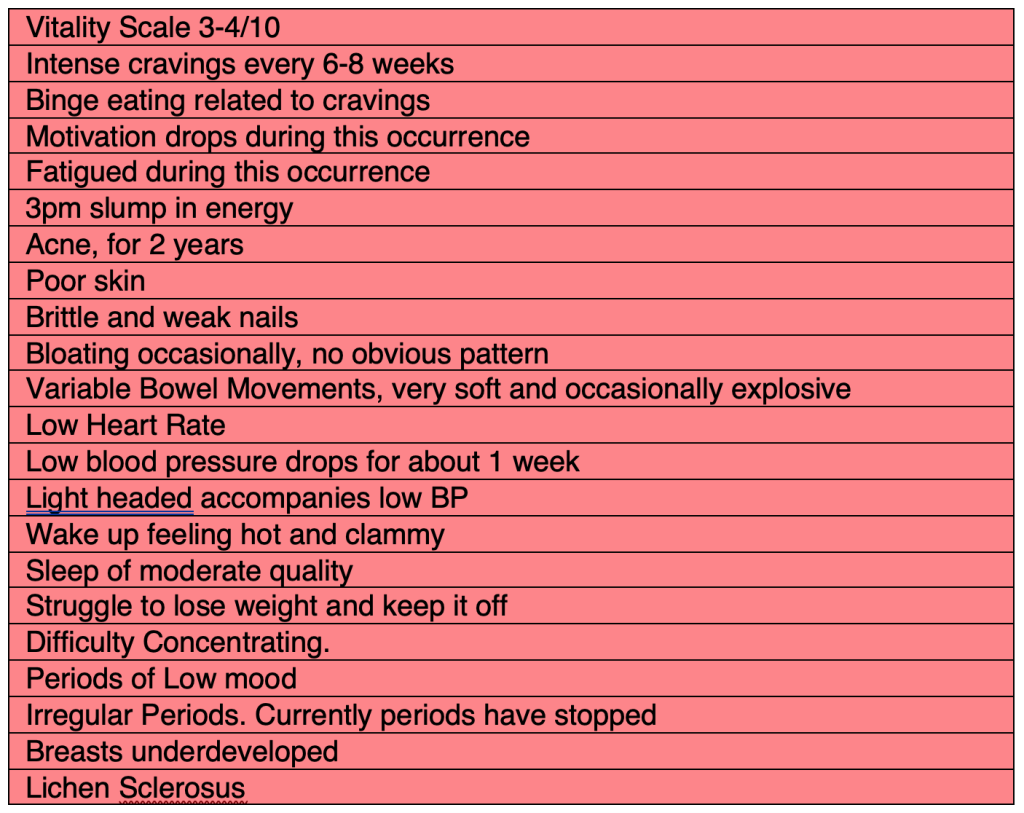
PRE Symptoms / Health Challenges
That didn’t happen and I had become obsessive over training, had a complete fear of not training and I was unable to enjoy good food without guilt and an array of other symptoms. I regularly binged, never felt satisfied after eating, had adult acne, poor bowel habits and my ceiling of potential in my training was significantly limited.
Timeline
Let’s put some context to this list of mild, moderate and severe health challenges.
Whilst this is the current situation, we always analyse the timeline of events. Not so that we can judge it as ‘right or wrong’ or with ‘should and shouldn’t’. Simply so that we can gain some insight, clarity and understanding of the situation.
From a Practitioner’s point of view this is vitally important. And from the individual’s point of view it can be very illuminating too. Especially when you don’t just look at it as a series of unconnected events and instead, as a process of experiences and responses that the person and whole system-of-systems has had.
So let’s take a look at some aspects of Nicki’s Timeline.
Anorexia Eating Disorder Hospitalisation
10 Years prior to our work together Nicki had been diagnosed with an Eating Disorder called Anorexia.
NEDA, the National Eating Disorder Association define Anorexia nervosa as: “An eating disorder characterized by weight loss (or lack of appropriate weight gain in growing children); difficulties maintaining an appropriate body weight for height, age, and stature; and, in many individuals, distorted body image. People with anorexia generally restrict the number of calories and the types of food they eat. Some people with the disorder also exercise compulsively, purge via vomiting and laxatives, and/or binge eat.”
At the time she was admitted to a Special Eating Disorder Hospital Unit for 2 weeks, then spent 4 months as a day patient with daily attendance. After 1 year she had been progressed passed the most intense stages of Anorexia, but over the next 9 years she battled with these symptoms.
She’d been through and achieved a lot, had the condition managed, but felt that the traits and behaviours were bubbling beneath the surface and still impacted her relationship with food, exercise and her body.
Zero Diagnosis or Treatment
As a Functional Health Approach we always emphasise that we do not make diagnoses or name conditions. That is the remit of the Medical Profession. Once a Medical Diagnosis has been made, that then enables that medical process to move to considering the next step of ‘Treatment’.
Again, a functional approach does not use the term or apply steps of ‘treatment’ because it literally has no ‘condition’ to treat.
Each remit and therefore model is different.
Not better or worse.
In fact, the Medical, Functional and all other models all have advantages and disadvantages, benefits and drawbacks, that we are wise to consider.
In fact, the skill set regarding achieving the desired outcome of health goals (whatever, they may be), usually involves how you may integrate the different models and approaches appropriately. How you decision-make your way through to put safe and effective steps in place that progress you towards your goals is certainly quite a challenge.
We emphasise this often and did so for Nicki, because this is still an aspect that many will understandably find quite tricky.
Here at the Functional Health Clinic, our goal is to provide informed choice through grounded and balanced information to provide a safe and effective process.
So, in short, in Nicki’s situation, we were not there to diagnose or treat an Eating Disorder.
We were there to assess the function of her body and enhance its function where required.
Sleep Paralysis Episodes
Back to the Timeline and Nicki’s health history, with this very significant experience that she had been having relatively recently.
A few years earlier, during a very stressful final year of her degree she would often take a nap during the day to recharge. But often when she woke up she would be wide awake and physically could not move!
She would feel paralysis from the neck down and would need to lie there for a few minutes until it wore off and she could move again.
The NHS define this as “when you cannot move or speak as you are waking up” and “it’s not clear why sleep paralysis can happen” and that “it can be scary but it’s harmless and most people will only get it once or twice in their life.”
There’s no real description of the mechanisms and of course it is important to acknowledge that it is generally thought to be harmless.
However, this is certainly a significant indicator of how much load, stress or demand the body is under/experiencing. It’s an intense version of ‘fight, flight or freeze’.
The Sympathetic side of the Autonomic Nervous System (ANS) seems to be in a significant state.
Nicki also had had some similar experiences when studying exams at school. She would often be found by her Mum just talking to herself, almost in a zone of replaying information and details from her studies.
Again – this is not necessarily something detrimental, but certainly interesting in a demonstration of how much influence and connection the Psychological, Physical and Physiological aspects of the human body have.
Take a quick look back at the list of the pre-symptoms and consider how all the different systems are involved and responding:
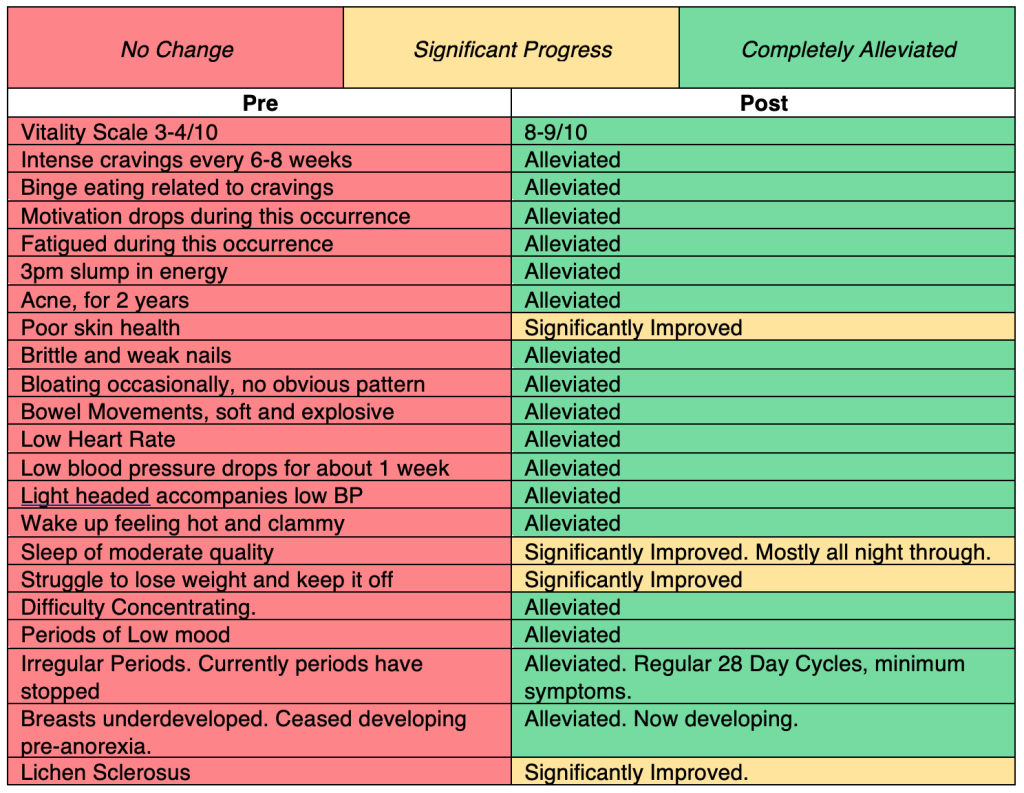
Vitality Scale 3-4/10
Intense cravings every 6-8 weeks
Binge eating related to cravings
Motivation drops during this occurrence
Fatigued during this occurrence
3pm slump in energy
Acne, for 2 years
Poor skin
Brittle and weak nails
Bloating occasionally, no obvious pattern
Variable Bowel Movements, very soft and occasionally explosive
Low Heart Rate
Low blood pressure drops for about 1 week
Light headed accompanies low BP
Wake up feeling hot and clammy
Sleep of moderate quality
Struggle to lose weight and keep it off
Difficulty Concentrating.
Periods of Low mood
Irregular Periods. Currently periods have stopped
Breasts underdeveloped
Lichen Sclerosus

Let’s Get This Program Started
Beyond looking back and reflecting on the timeline and analysing the health history, when we can help somebody, we are keen to get started as soon as possible.
We have a process we want to put in place and we’ll take a look at this comprehensive Health Restoration Program process in a little more detail later on.
The steps and strategies will range from anything from quite basic and simple to complex.
However, they are all individualised.
Yes – Even the simple stuff. The steps that just feel like good practice, or obvious. They need to be prioritised/individualised too.
Try to avoid falling into the trap of generally making general changes for general reasons!
Ultimately there are many, many steps that fall under this category, so it still requires some consideration and design.
Remember – that whether you are applying a ‘basic’ change or something more ‘complex’ – your goal is for it to be effective and to achieve significant progress.
Progress After 7 Days
After just one week of initial changes Nicki was experiencing an increase in energy and was becoming much more mentally focussed. Her sleep quality was improving, skin starting to clear, cravings reducing and she was more satiated after eating.
Not only this, she was also much more aware and noticing more links and connections between what she was doing (actions) and how she was feeling (outcome).
Whilst the rapid improvement in health is fantastic, the fact that she was becoming her own Detective was even more important.
The specific-basics that we had put in place for Nicki included:
– Adding in a carrot salad
– Reduced her intake of ‘green’ vegetables, following an interesting discussion on this dogma!
– Introduced goats milk and yoghurt.
– Added in more white fish.
– And added in a de-load week to her exercise and training routine.
So clearly some if not all aspects of these changes were enhancing her function.
After all – symptoms – are an inbuilt Feedback Mechanisms to teach us about dysfunction.
The greater the expression of our functional blueprint, the less symptomatic feedback we’ll receive.
But let’s rewind a little. Prior to week 1, we had run some assessments. We are always looking to support the process of gaining more clarity on the situation so that these steps can be much more targeted.
Assessment Number 1 – The Gut
The Gut Health Test (GI Map) is one of the tests we often run with our clients. There were a number of findings here that felt like they would be more fine-tuning rather than ‘big-hitters’. Useful in their own right, but in turning this stone over, we also knew that we’d benefit from turning more stones over. We had more digging to do.
Yet – there was one very important marker called ‘Secretory IgA’ that came back Low on her gut health test.


We often see this come back low with the clients we work with, so it features quite often, but it was very significant for Nicki due to how low it was and especially considering her age.
She was only in her mid-twenties. Quite young, and you’d typically expect more robustness and balance in this sIgA marker at that age.
Secretory IgA Marker:
Secretory IgA, or sIgA, is a class of antibodies produced by and secreted from mucosal surfaces, especially the GI and respiratory tracts. In the gastrointestinal epithelium, sIgA is the first line of defense against the entry of enteric toxins and pathogenic organisms from the colon. This is a sign that it has been under a large workload and is running low on power, together with the fact that increased stress hormone production suppresses the levels. The gut/body becomes more vulnerable to invaders and pathogens (bugs, bad foods, toxins, allergens etc).
So we now have to be asking the questions what could have suppressed this level in a mid-twenty year old?
As you might expect, there could be numerous considerations. But the key areas to focus on for Nicki were her approaches to Nourishment and Exercise, which we’ll take a look at next.
Balancing the Exercise
 In short – her training routine was too intense and she was not recovering effectively. Too much depletion, not enough replenishment. Too much breakdown (catabolic) and lacking build up (anabolic). Excess challenge, insufficient support.
Here is Nicki’s routine that she was following before the program. She was Training 6 days a week including:
– 1 x 90minute session of weight lifting per week
– 5 x Metcon (metabolic conditioning) per week
– 1 x Bike 30-40 mile session per week
– 2 x extra morning sessions of running/cardio per week
There are layers and drivers as to why she was exercising the way that she was. All useful and valid. Each layer, an important consideration when creating a balanced approach to exercise that was congruent with her vitality and performance goals.
But – at that point in time, it wasn’t really complementing either.
Before we delve into the nuances of her ability to turn movement into her medicine, it’s really important to acknowledge that there is no judgement on any particular mode or modality of exercise.
We leave the debates and opinions to the online forums!
We simply appreciate that each training program, method, exercise etc has advantages and disadvantages.
The skill is in applying it effectively to achieve whatever it is you are aiming to achieve.
And that goes for CrossFit too!
A Love of CrossFit
CrossFit is a great example of extremes of opinion around exercise and movement. Some praise the benefits of training such a variation and range of energy systems and movement patterns, whilst others criticise how much damage it can do with poor physical technique and form and physiological stress it can cause.
Ultimately, this and all other movement options will complement some situations and potentially be detrimental to others.
So, it is more a case of how someone is applying their movement and exercise choices. Which, in itself is often a learning process too.
She really loved CrossFit too. Many aspects of it. Social, focus, environment, atmosphere, friends, community, format, structure, challenge etc. So what we wanted to achieve was something more balanced, that delivered on as many fronts as possible.
Rather than just say “don’t do CrossFit”.
Exercise for Vitality and Fitness
Changing the focus from ‘exercise for fitness’ towards applying some ‘exercise for vitality’ made a huge difference.
The early change of giving herself a de-loading (easier) week already had a big impact.
If you don’t create the space and time to recover then you spend more time in a Sympathetic state. Continuously lift, run, cycle, push, pull, climb and challenge and you are literally emphasising the ‘fight and flight’ nature of the situation.
Now – all those exercises can actually work and do those things for you. But only if applied wisely.
So the body responds by sending resources to support those needs. More stress hormones like cortisol and adrenaline are prioritised over the growth and repair hormones such as testosterone and progesterone etc.
Not only would this affect factors like energy and strength, but it would impact functions from hormonal balance, digestion, immune, blood flow, brain function and many more.
With the changes Nicki made to avoid this, now the body was getting the opportunity to create a balancing response.
It also meant that Nicki could still engage and participate in this type of training environment. Just with some adjustments in the variables.

Variables Between the Extremes
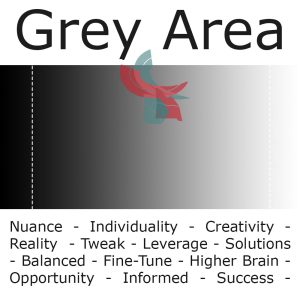
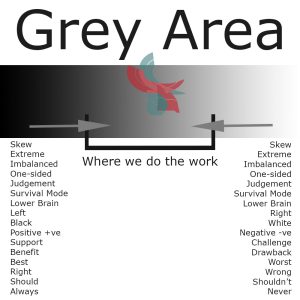
The great thing about this fine-tuning is that you find out just how many variables there are. Each variable is essentially an opportunity to make a change towards something that gives you a more desired outcome.
Instead of feeling like it is all or nothing, or that there is failure in doing less, the grey-area of variables can be embraced.
It’s also relatively simple. Take a look at some of the things she changed:
– Less frequent training sessions weekly.
– Each session was shorter in duration.
– Reducing intensity of each sessions.
– Allowing herself to adapt and adjust the session depending on how she felt.
– Rest days included recovery strategies, rather than just ‘not exercising’.
This also freed up some of her time and energy to reinvest into her more therapeutic strategies that we had waiting in the wings.
Therapeutic Movement
Nicki’s go-to was clearly the challenge/yang side of exercise rather than the relaxing/yin side. However, she really saw the value in it and prioritsed some time towards more of the energising, recovery, therapeutic and restorative application.
This was a perfect example, of not having to infatuate completely with the ‘movement is medicine’ gentle side of exercise and breathing exercises in order to be successful. A skilful, simple, efficient application into the routine and that’s all it took.
These steps took a few weeks and months to build in, but soon she was in a rhythm and able to create training plans with a structure that worked and yet were also flexible and open to adjustments.
She could train harder, was getting more gains, out-performing her CrossFit training partners, recovering well and in a flow with her thoughts and feelings around training and not-training.
……….. So, circling back to the Secretory IgA marker, even though we’d just ran a gut test, the insight really enabled us to prioritise the importance and impact of the current approach to exercise.
GI Map Fine-Tuning
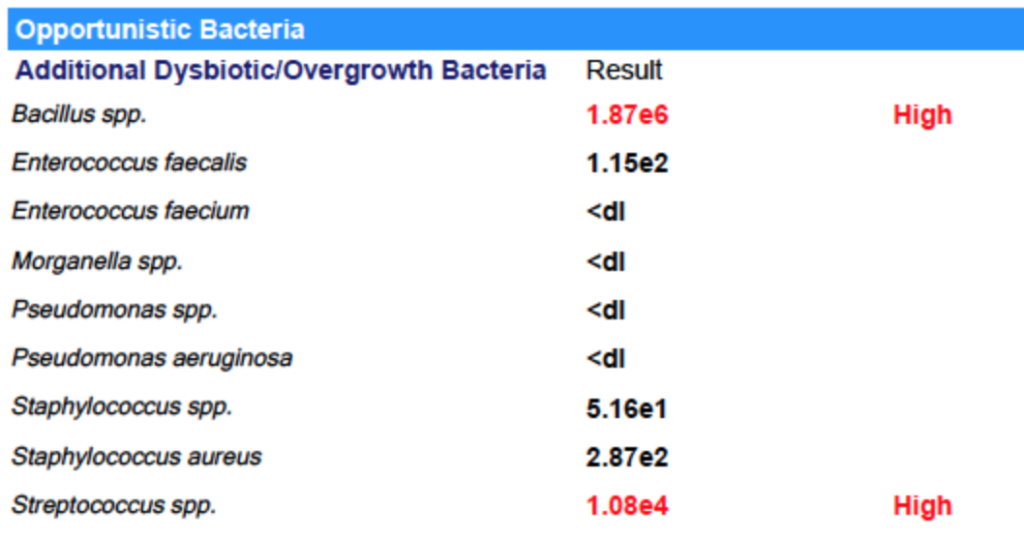
The GI Map test also gave us some further insights. Yet these were definitely more subtle:
– A Borderline High level of Helicobacter pylori bacteria.
– Opportunistic Bacteria Overgrowths
– Borderline Low Pancreatic Digestive Enzyme levels
We also had some Organic Acid Test markers of fungal dysbiosis.
And the GI Map assessed many further aspects of gut function and found them to be perfectly normal and at optimal levels, including:
– Pathogenic infections
– Inflammation
– Gut Toxicity levels
– Fat digestion
These were helpful areas to enable some focus, but also ensured that we could prioritise our efforts and resources on the areas that required attention. Rather than playing hit-and-miss with the strategies.
Probiotics – The Roulette of Guesswork
The drawbacks of guessing your way through the process and crossing your fingers that the next strategy will work, was something Nicki had already been experiencing prior to contacting us.
A perfect example was that due to her digestive symptoms she thought she’d try a probiotic. It sounded like a good idea and that it couldn’t do any harm. Yet, whenever she took a probiotic it would make her skin worse and irritate her gut.
The principle here is that all products and supplements have their potential drawbacks. They only really work when your body has an actual requirement for them. So much so that they can actually push you out of balance when you don’t need them.
Probiotics are a perfect example of this. They are often given a ‘free-pass’ due to the current infatuation with the ‘microbiome’. Especially when so many people take them based purely on symptoms, as opposed to any measurement or assessment of their body’s need. That’s not ‘wrong’, but it is higher risk.
Dogma Omega
Another example, and a common one we observe is the pitfall of omega oils. There’s a dogma surrounding them and an assumption that everyone will do well on them. Such a one-sided view simply means that half the information is missing. In this case the information on how omega and these types of polyunsaturated fats and oils can sometimes be detrimental to a person’s biochemistry.
That doesn’t mean always. It simply means it is ‘individual’. Just like every factor and Nicki found that she was actually feeling worse on the various omegas and oils she had tried to supplement with in the past.
Whilst she’d found this frustrating in the past, we were quick to clarify the whys around this so that she could at least understand her body’s response and stay focussed on identifying more strategies that would work for her.
[We’ll delve deeper into the Polyunsaturated Fatty Acid Topic in a future Case Study]
A Walking Digestive System
Well, thankfully we aren’t actually a walking digestive system!
It’s an important and influential function and system to assess of course….. Yet that does not mean we need to put the blinkers on and reduce ourselves down to everything being about the ‘gut’.
That’s more of a pitfall than anything else.
Perhaps you’ve experienced this scenario before? When a symptom, area of the body, a test result, a named condition, becomes almost like a label. An exaggerated part of your identity and seemingly ‘only’ factor involved in the challenge in front of you and the solutions you’re looking for.
Perhaps not!
But just because Hippocrates gets quoted as stating that ‘all diseases begin in the gut’ – doesn’t actually mean that a) it does, b) that they actually even stated this, or c) that even if they did, it was a long time ago and they may have changed their point of view by now!
However, many others still haven’t. Practitioners, Authors, Researchers, Teachers alike, all exaggerating the role the gut may be playing.
We prefer to acknowledge the integrity of the ‘system of systems’ principle and stay as grounded as possible on the influence of the different systems and factors at play.
And we want this for our clients like Nicki too.
We Needed More Insight
Therefore, it was clear that we need more insight beyond the Gut.
Let’s take this opportunity to highlight the R-Phases that we teach.

We’ve created the stages and phases of the Health Restoration Program so that we can coach our clients a Process. There are so many aspects to share (Principles, Assessments, Strategies and all the why’s and how’s), that we have a structure and framework in place in which to teach each step.
The ‘we need more insight’ phase is the ‘Reveal’ Phase.
Assess instead of guess and so on.
Comprehensive Blood Chemistries are at the Heart of it
The Functional Analysis of a Comprehensive Blood Test has become the fulcrum of the Functional Lab Testing that we do.
In itself it brings an enormous amount or insight, clarity and direction.
But it also helps to pull all the other lab tests and findings together.
We recommended that Nicki ran a blood test that included:
- Metabolic Panel
- Lipid Panel
- Thyroid Panel
- Iron Panel
- Iron Panel
- Additional markers such as Vitamin D, B12, Folate, CRP and more.
As Nicki’s GP ran the test for her, many of these were missing, but we certainly had plenty for it to be of great value. Take a look at the markers we found to be outside of an Optimal Range.

Functional Blood Chemistry Analysis
A ‘Functional’ Health Approach involves running a functional interpretation of the blood test results.
In basic terms, this means we use different ranges/norms to compare the results to. We are looking to identify anything that is outside of an ‘optimal’ level for that marker.
This is a different remit and interpretation to the conventional Medical blood test analysis. Which doesn’t mean ‘better’ and it is still a case that both interpretations add value to understanding the function of the body and intervention options.
We also took the time to review Nicki’s previous blood tests and could see that there were a few patterns that had been present for at least 1 year (since her last blood test).
[Definitions from https://labtestsonline.org.uk]
Low Haemoglobin and Haematocrit Levels
“Haemoglobin carries oxygen from the lungs to the cells.”
“Haematocrit is a measurement of the proportion of blood that is made up of cells. It falls to less than normal, indicating anaemia, when your body decreases its production of red blood cells or increases its destruction of red blood cells.”
This can relate to iron deficiency and something called microlytic anaemia (small red blood cell size).
However, Nicki’s slightly High MCV marker suggested it would not be a microlytic issue.
Yet, the markers the GP had chosen for the blood test had not included any Iron Panel markers, so we couldn’t rule this in or out. If our work had gone beyond the 3 months this would definitely be something to be added in the retest.
So what we were working with was a likely Pattern of Iron Deficiency.
Iron
Iron is an essential trace element, needed for numerous biological functions. Including:
- Red blood cell formation
- Mitochondrial ATP synthesis
- Antioxidant activity
Decreased iron status can negatively impact oxygen transport to the tissues, hence the likely fatigue. There will also be metabolic inefficiency and lead to symptoms of iron-deficient anemia.
Causes to consider for Nicki’s case were:
- Diet: Inadequate iron-containing foods
- Low gastric acid
- Drugs that deplete iron
- Uterine fibroids
- Genetic predispositions
- Toxicity
Iron and Aluminium Toxicity Link
Working over a short period of time like 3 months does not give us the ability to thoroughly investigate a specific heavy metal toxicity. Therefore, we certainly don’t have the necessary measurements of Aluminium toxic burden for Nicki.
And whilst Nicki did not actually require this angle of support work to be successful, it’s still an interesting part of this process and worth discussing briefly here.
Because we did have these key markers:
- A High level of Aluminium accumulation in the Hair Tissue.
- An exposure history of using aluminium based deodorant/antiperspirant sprays since being a teenager.
- High Aluminium levels can be linked to a pattern of iron loss due to destruction of body cells.
- Aluminium has been linked with displacing calcium in bone (see later discussion on Nicki’s Calcium status).

And there are plenty of aluminium exposure sources too: cans, food cooked in aluminium cookware, use of aluminium-containing antacids, use of anti-perspirants, drinking water, (aluminium is frequently added to municipal water), baking powders, drying agents in salt and other products, processed cheese, bleached flour, fluoridated water increases leaching of aluminium from aluminium pots and pans.
In very simple terms, hair tests are useful in understanding toxic burden, but they can’t show you everything you may need to know.
But one thing is certain (short of contaminating a tissue sample) if you have Aluminium in the hair tissue, then it has come from the body.
Nicki’s High Aluminium suggest that her body burden is relatively high and that she is eliminating some of it out through the hair tissues.
In many ways this is an excellent sign. Why? Well, not because you would choose to have high levels of Aluminium in the body, but if there are high levels, then the next thing to want in place is the ability to eliminate it.
It may often take several hair tests before aluminium is revealed on the test. This is because the aluminium may be tightly bound within body tissues and several months on a ‘nutrition’ program may be required to mobilize the aluminium.
Given the nature of the data and duration we had, we focussed on the Foundational Factors for Nicki during her program. Ensuring that her elimination and detoxification pathways were supported.
And she also switched her under-arm spray to using some more natural products and approaches.
In consideration with some other findings too she did also carefully apply some use of ‘Silica’, in the form of Bentonite clay baths and Gut Binders.
Chronic Low Blood Pressure links to Iron Deficiency
Once we were equipped with the above insight we were also in a stronger position to consider drivers and changes that could impact the low blood pressure that Nicki had been experiencing for a long time.
After 6 weeks this was improving to the point that episodes were much less intense and occurring less frequently.
By the end of the program her low blood pressure was alleviated completely.
Whether this was all related to the relationship with iron status is impossible to say, as there are so many factors involved. But it certainly appeared to be an important piece of the puzzle.
Nicki’s Nutrition and Iron
We supported Nicki to build her approach to nutrition one step at a time. On analysis, her diet was lacking the key sources of iron.
Her protein sources were dominantly: Vegan protein powder. Tofu, Vegan meat alternatives, nuts and legumes.
This are a real concern in such a situation.
The most effective dietary sources of Iron are known as heme-iron rich foods, such as liver and red meat and whilst these were not Nicki’s first choice, she worked hard to add in some higher quality animal protein sources.
She also reduced the meat alternatives, nuts and seeds – identifying that she was not doing well on them and their contribution to some of her digestive symptoms.
High TSH, but Limited Thyroid Panel
“TSH is made by the pituitary gland, a tiny organ located below the brain and behind the sinus cavities. It is part of the body’s feedback system to maintain stable amounts of the thyroid hormones thyroxine (T4) and triiodothyronine (T3) in the blood.”
We see this so often. A really limited Thyroid Panel. The TSH marker just doesn’t give enough of the picture of Thyroid function. Especially if you want to identify and differentiate between Autoimmune Thyroiditis or Non-Autoimmune Functionally Decreased Thyroid Function.
The Thyroid is known as the gland of ‘metabolism’. Our metabolic rate and therefore ability of each cell to function is directly related to the function of the thyroid.
This was a significant finding given some of her related symptoms and patterns – fatigue, anaemia, difficulty losing weight, digestive disruption, mood challenges and more.
Ideally – and again, if Nicki had required more in depth investigation, we would have wanted to do some deeper digging. We’d have wanted to run a more comprehensive Thyroid Panel that included markers such as:
- T4
- Free T4
- T3
- Free T3
- Reverse T3
- TPO Antibodies
- ThyroGlobulin Antibodies
Furthermore, it is important to analyse other physiological factors that are related to the thyroid, which may include:
- Liver function – the conversion of T4 to T3 takes place primarily in the liver.
- Oxidative stress – a decrease in glutathione status can impact T3 synthesis.
- HPA stress hormone balance – fluctuations in stress hormones.
- Intestinal immune function: microbial balance, food intolerance, intestinal permeability.
- Various nutrient deficiencies: B-12, B-6, zinc, selenium, iodine, glutathione, tyrosine.
Essential BioMeasures Insight
To make up for what we were lacking in thyroid blood chemistry markers – we did have Nicki’s Biomeasures.
These are quick and easy home tests that we teach all of our clients. We have around 5 of these tests, but the initial key ones that we collect are resting Underarm Temperature and Heart Rate.
Nicki’s biomeasures at the beginning of the program:
Resting Pulse ranged from 44 to 57
Resting Underarm Temperature ranged from 35.1 to 36.4
Resting Pulse Wisdom
The result of my conventional academic journey including Bachelors and Masters Degrees had concluded in a certain understanding of what a healthy resting pulse rate was supposed to be.
Sometimes the emphasis would be on the average beats per minute being around 72. But there was also a notion and emphasis that the lower the resting heart beat the better. That ‘lower’ was a sign of fitness and that meant greater vitality.
[Maybe I just wasn’t concentrating well enough in those lectures and I missed something] – but there are major flaws in this theory.
There is a whole context missing. A context that explains and demonstrates that ‘lower’ is not always better with resting heart rates.
The driving force of this missing context is that ‘Fitness = Health’.
We are either going to find out the hard way (a wake up call) or the easy way (educate) that this simply is not the case.
Whilst many elements of ‘fitness’ can complement to high vitality levels and health, many aspects of fitness can also contribute to the absolute opposite.
Consider that a lower resting heart beat may be a response to the training demands placed upon it. For example – a Tour De France cyclist. The heart anatomy and physiology responds in a way that directly adapts it to be more efficient under these specific conditions.
That is a very specific scenario. Extrapolating that out to state that it is also effective for other scenarios of vital function is erroneous.
The greatest Tour Cyclists had resting heart beats as low as 26 bpm! Whilst this is an extreme example, if this notion is true then the cardiovascular system would also have been congruently optimal at all levels of functions.
Yet – when sleeping, some of these cyclists need to set an alarm at night in order to get up and jump on a stationary bike and cycle. All in order to keep their heart beating and prevent it from stopping and their body shutting down!
Incredible levels of fitness for a specific demand. Yet not fit-for-purpose of keeping the body alive when sleeping. And I’d put that down as a Foundational factor!
When ‘Low’ is not Better
There is a considerable amount of evidence to suggest that a healthy resting heart rate is between 70 and 80 bpm. And yes – when stuck in the perception that fitness = health I would have struggled with that idea too!
More often than not our Functional Health Clinic client resting pulses are well below this. Is that because they are all super-fit or is it due to other factors?
Given that we work with clients who are experiencing a myriad of chronic health challenges, it is not likely to be a marker of high physiological performance. At that time.
When you look beyond ‘fitness’ – there are so many factors and functions that govern a resting heart rate that it is clear that this output is ultimately to do with the capacity and vitality of these.
Therefore, it is wise to consider:
- Thyroid Function
- HPA Axis (Hypothalamus, Pituitary, Adrenal)
- Nutrient Status
- Electrolyte Levels
- Hydration
- Inflammation
- Toxicity
- Structural
With Nicki and all our clients, we prefer to acknowledge this and begin to investigate to create robust function throughout the body, whether that is cardiovascular, metabolic, digestive, immune etc.
Rather than just say – “its low, that must mean you are very fit, trust me, I passed an exam on it at university.”
Grounded Resting Heart Rates
Remember this ‘cyclist’ is a more extreme example to illustrate a point. This doesn’t mean everybody should have the same resting heart rate or that lower heart rates are always a detrimental sign.
It means that whatever your heart rate is – find it interesting. Track it and begin to understand it in relation to your goals. Whether they are fitness, health or both.
The essence of this is to avoid making the judgements of what you think a resting heart rate ‘should or shouldn’t’ be. This is what Nicki was doing initially.
Simply track it. Check and balance it.
Our clients at the Functional Health Clinic will be tracking their Biomeasures over a number of months whilst we are working together and we get to add meaning and context to whatever it is and as it changes.
Underarm Temperature
This marker is a little more clear-cut.
Body temperature gives you direct insight into your cellular energy production. The enzymes and all their chemical reactions perform efficiently in a warm environment. If our core is ‘colder’ and metabolism inefficient then the capacity of our whole body is diminished somewhat. This would be called Entropy – a state associated with disorder and breakdown.
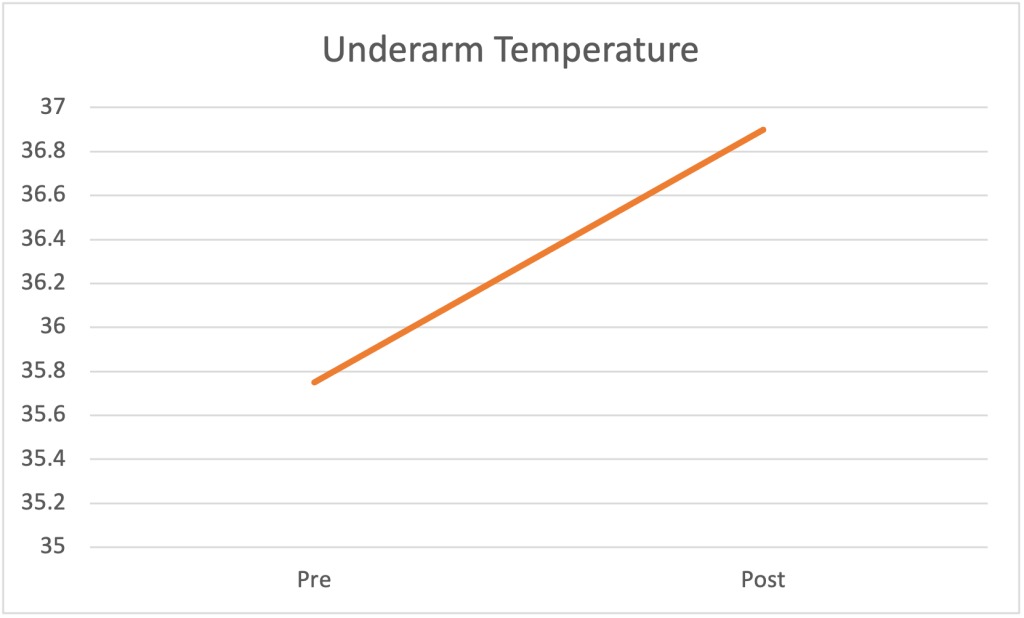
Nicki’s pre underarm temperatures were 35.1 to 36.4 which fall significantly below the optimal level of 36.6 to 36.8.
Which would suggest a low metabolic rate.
Yet, for Nicki, this was just a fantastic opportunity. Great insight, with which she could track and empower some changes. Some research suggests that raising core temperature by 1°C is associated with a 10% to 13% increase in metabolic rate – which would greatly impact her health and her strength and conditioning performance.
Nicki’s BioMeasure Retest Results
I appreciate this Case Study is quite long, but if you read through you’ll be able to appreciate the range of steps and angles that Nicki covered in order to support her cellular engines and metabolic rate.
Was it one thing in particular or a culmination of focus on nutrition, psychology, gut, nnEMFs, balanced exercise and movement, sleep, hydration etc?
Within 3 months this is what Nicki achieved:
Resting Pulse ranged from 58 to 59 (pre 44 to 57)
Resting Underarm Temperature ranged from 36.8 to 37.0 (pre 35.1 to 36.4)
When you align these with how she was feeling pre and post, she now has much greater clarity on what her physiology can tell her about when she is at her best.

Thyroid Insight from Hair Mineral Analysis
We were busy looking at ways to get valid feedback from the body despite not having the comprehensive thyroid markers.
The next place we looked was the Hair Tissue Mineral Analysis test. A Test that I wouldn’t run in isolation, but one that is very insightful when alongside other tests such as a comprehensive blood test, organic acids test and gut health test.
In particular, we were interested in one of Nicki’s Mineral Ratios. The Calcium to Potassium or Ca/K ratio.

Did you know it’s often more meaningful to look at ‘ratios’ of minerals, rather than just absolute levels of individual minerals.
This helps us understand the functions that they relate to. In the case of Ca/K this is Thyroid function.
It can scratch the surface of your physiology’s performance. With or without the presence of symptomology!
For example – this Ca to K ratio provides insight into Thyroid function for several reasons:
- Adequate Thyroid hormone levels can regulate calcium to required levels.
- High Calcium levels can affect the permeability and correct function of cell walls/membranes.
- Potassium is required to sensitise cells to the thyroid hormone.
As you can see on Nicki’s HTMA test the Ca/K ratio is high. It’s 29.2:1 and optimal is around 4:1.
So this is a case of far too much Calcium compared to Potassium levels (in the hair).
The complexity of hair tissue mineral analysis is not what we’ll go into in this case study, but here we had more markers of not only how the thyroid could be a piece of the puzzle, but also what may be the driver of the thyroid dysfunction.
Looking at how the mineral Calcium was being displaced and shunted out of the body (lost) would be a pivotal consideration for this case.
Which of course brings us back to the importance of considering the earlier HTMA finding of possible Aluminium toxicity that may influence the displacement of calcium from bone tissue.
Calcium Status and Eating Disorders
And indeed for Nicki, the calcium pattern may be even more useful in terms of understanding the impact of her challenges with nutrition and perceptions around nutrition in the past.
We described earlier how Nicki had, 10 years previously, been admitted to hospital and diagnosed with Anorexia. Over the next 9 years she had worked extremely hard to progress through this and be in a much better place with her nutrition. However, she was still experiencing certain traits around her relationship, perceptions and behaviours around food.
So, working together, we simply acknowledged, regardless of diagnostic conditions, this could have had a significant impact on her physiology and function over the years.
That’s exactly why the Medical System will typically run a Dexa Scan for Bone Health and Density in situations of extreme eating patterns. Many years earlier Nicki had a Dexa Scan and was advised to improve her calcium status with supplementation. Whilst she had not had another scan since, we ensured we checked her CBC Calcium levels and they were currently Normal.
The Drs are checking the integrity of this structural tissue and how the Calcium mineral status has been impacted. Their concern is that in such a catabolic state there could be breakdown due to calorie/nutrient restriction and deficit and calcium loss from the bone.
Well – an HTMA is not the same as a DEXA scan. Clearly. But it is a measurement of calcium and other minerals in another tissue (hair) of the body. Research into hair analysis would suggest that this ‘high’ marker is related to calcium being lost from the ‘hard’ and structural tissues of the body.
A functional pattern that may not be so evident in the blood tests.
Quite a fascinating pattern to uncover for Nicki. It supports the process of understanding what may be happening in the body, how different factors impact it and what the next steps and solutions could be.
And definitely a great case for running another HTMA at some point in the future (to look at the calcium mineral ratios and the Aluminium levels).
Thyroid Nutrition Steps
What did we do with all this ‘thyroid’ and metabolism evidence?
We actually kept it quite simple and focussed on Nutrition. This will usually be the most effective rather than overly focussing on the supplements or ‘miracle cures’.
Nicki’s steps to success:
- Care with brassicas and cruciferous (well-known anti-thyroid foods)
- Consuming more food (fuel)
- Moving away from meat alternatives
- Reducing Soy
- Increasing protein quality
- Some ‘Oxalate’ work (due to Organic Acids Test elevated marker)
- Clearing the dogma around carbohydrates and sugar (metabolic fuel)
The body is designed to perform. The cells are waiting for the ingredients. When supplied, the cells create enormous amounts of energy and the body runs smoothly(er).
What we really need to ‘Check and Balance’ are the reasons why we haven’t delivered what the cells actually need in the first place. That’s the individual and therefore, interesting part!
Indirectly we also considered all the other individual factors we knew about her body and how working on these areas could complement her metabolism too. Enabling the cellular engines to rev!:
- Opportunistic Bacteria
- Fungal Overgrowths
- Nutrient Deficiencies
- Digestive Capacity
- Immune Support
- Over Exercising
- Sleep Quality
- Etc
Low Protein and Low Globulin CBC Markers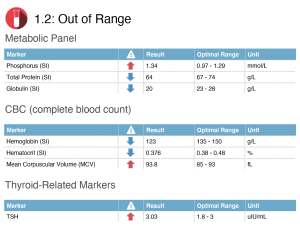
Back to the CBC.
“Total protein measures the combined amount of proteins the two major two classes of which are albumin and globulin.”
ImmunoGlobulins such as IgA line the intestinal tract and as we have seen in the GI Map, this first line of immune defense was low.
Therefore, we really required a focus on anything that could cause dysfunction and inflammation in the Gi Tract, for example:
- Food intolerances and or allergies: gluten, dairy, soy, corn, etc.
- Food groups (FODMAPS, nightshades, high oxalates, high sulfur, high salicylates, etc).
- Pathogenic infections
- Yeast/fungal imbalances such as candidiasis
- High chemical & heavy metal toxicity
- Endotoxins
The Importance of Low Glomerular Filtration Rate
“Glomerular filtration rate (GFR) is a measure of the function of your kidneys. Glomeruli are tiny filters in your kidney that allow waste products to be removed from the blood, while preventing loss of important proteins and blood cells. The rate refers to the amount of blood that is filtered per minute. When a person’s kidney function declines due to damage or disease, the filtration rate decreases and waste products begin to accumulate in the blood. A measured GFR is considered the most accurate way to detect changes in kidney status”
We were a little surprised that this had been coming back consistently low on Nicki’s Doctor’s tests, but they stated that they were not too concerned about this result or her kidney health.
Importantly – over the previous 12 months it was also getting lower!
Therefore, we felt that this was indeed an important piece of the puzzle and a pattern that needed to be reversed.
Thankfully – 1 month into our coaching program it had begun to improve and another 2 months later it was finally Normal.

So – it’s fair to say that Nicki really squeezed the value out of her Blood Chemistry……
Functional Lab Test Suite for Clients
Gut Health
CBC

Organic Acids

Irregular Menstrual Cycle
The topic of ‘Hormones’ was a really important one for Nicki. There were key points in her timeline and feedback from her body (symptoms) that emphasised just how influential and influenced they were.
Afterall – all the systems in the body are linked.
Yet (and this will familiar to many) her Doctors Hormone Blood Tests had all come back ‘Normal’.
During puberty her breasts ceased developing.
For long periods of time Nicki’s periods just didn’t occur.
Nicki had then spent 6 years taking the birth control pill and when she stopped taking it her Menstrual Cycle did come back, but was very irregular. Either very short or very long/absent (3-5 months). As her Dr’s test results were normal, the advice was it would just take time to normalise.
That may be so, as the body is designed to express the blueprint.
But, why just leave it to chance? Or down to just one factor – time? Why not dig and see what other factors you can find? Why not optimise and support the process?
So it was quite amazing for Nicki to report that within just 3 months she was experiencing quite extraordinary changes.
Her Menstrual Cycle was now regular at every 28 days, with minimal symptoms.
And even more significant for her was the fact that now, in her mid-twenties, her breast tissue began to develop again!
Functional Hormone Balancing
From a ‘functional’ perspective we often have to acknowledge the power in the principle of begin a ‘system-of-interconnected-systems’.
When you’re in a situation of experiencing many different health challenges in various different systems (gut, immune, hormone, skin, muscles, joints etc), then it can feel like this principle is ‘working against you’.
For example – Poor digestion, leading to nutrient deficiencies, leading to poor sleep and fatigue, impacting on exercise level, lifestyle and motivation, causing more stress to the digestive system, an increase in stress hormones and then an disrupting impact on the sex hormones. And so on….
However – the very same principle and connected relationship of all the functions, systems, tissues, organs, glands and cells of the body means that you can endeavour to make it work for you.
The blueprint is designed to work for us.
Leverage it in order to move towards your goals.
Afterall – Nicki achieved these massive improvements in her ‘hormonal’ health and function without specifically being ‘on’ or ‘following’ a hormone balancing program.
She just acknowledged the inherent design of the human body, applied a process and made changes that were congruent with this.
Health Restoration Results – POST Symptoms
Non-Judgemental Mastery
At the Functional Health Clinic we have a high value on teaching some level of individual mastery. Not in a particularly profound way or a way that appears more righteous and almost unattainable. Or even mystical.
But in a grounded way that endeavours to remove the level of judgement of right or wrong, should and shouldn’t, good and bad and so on.
When you do this, ‘mastery’ becomes a simpler process of:
- Identifying what helps you progress towards your goals and embracing it.
- Identifying what prevents you from progressing towards your goals and creating changes here.
That’s why we don’t see the imperative need to be on a compartmentalised Program for this and that.
A gut program for the gut. Immune boosting program for the immune system. Brain training for the brain. Hormone program for the hormones. Etc, Etc.
That doesn’t mean that there is no place for this and that it can’t be part of the process for someone.
But how would that have worked in Nicki’s case?
Which program for what should she have been on?
What should the title of Nicki’s Case Study be? What would sum it up?
It’s tricky because her scenario does not really fit neatly into just one area of health. It’s a brilliant example of the true nature of our function.
Nutritional Creative Behaviours
In line with this focus on mastery of the process, let’s have a quick look into the behavioural side of her approach to nutrition.
Especially because we can appreciate that actually engaging in some ‘nutritional coaching’ can actually be quite daunting for someone who has been managing and addressing anorexia or any other eating disorder.
What if the coaching itself is delivered from a very skewed, dogmatic, judgemental, one-size-fits-all angle?

One month into the program and Nicki had been experiencing some significant improvements. I asked her what she felt the most important change so far.
“It has been nutrition and simply considering eating what foods I do well on, as opposed to eating what is ‘healthy’”.
What some people, authors, researchers, curriculums, practitioners, coaches…… would dogmatically define as ‘healthy for everyone’ can actually be unhealthy for many.
When you hold on to the way you think it ‘should’ be rather than the way it is, many topics, situations and health challenges become very, very confusing and frustrating.
It’s almost impossible to identify the reason why something is occurring if there is a strong belief that that couldn’t possibly happen.
A good example for Nicki was her Bloating. At the beginning, Nicki had no idea what was causing it. She couldn’t identify any kind of pattern or causation. It seemed like she was always bloated by everything and nothing seemed to help.
We worked hard through some grounding and rewiring steps to see if the answers and patterns were actually there.
Over the next few weeks Nicki was attending every session with more feedback about what was causing what. More awareness of the links between cause and effect.
Her bloating was most definitely impacted by gluten, nuts and seeds. Plus there was also a pattern related to her menstrual cycle (premenstrual increase in bloating).
With this clarity about her individuality she could focus on specific areas to address it and solve it.
Rather than treating her bloating generically like everybody else’s ‘bloating’.
She didn’t need an advanced lab test, specific technology or an expert or authority on the matter. Just a few human function/behavioural principles and the desire to ask questions, then ask yet more questions and be interested in the answers.
Transition through the Health Restoration Stages
The above ‘post’ results are one thing. But what we value most from the coaching program is whether the client has the ability to go from strength to strength. We’ll have endeavoured to pass on skills, strategies, techniques and principles that enable a spiralling effect of solving ongoing challenges and building, growing and developing further.
Over the four months I’d say that Nicki transitioned quite quickly and relatively smoothly through the stages of the HRP.

In fact I’d say that after 3 months of coaching, we arrived at the Rhythm Stage. Taking it beyond this and into the Flow stage was something that Nicki could master on her own.
Let’s use Nicki’s process and journey to take a look at the Foundation, Grounding and Rhythm Stage.
Foundation –
At the beginning of the journey or process it’s easy to feel overwhelmed by the situation or even information and options. It can feel chaotic and like you cannot see the wood for the trees.
Nicki’s capacity here was to get started, step by step and keep her changes focussed to key areas, rather than trying to do everything.
Grounding –
Getting started is one thing – but it doesn’t guarantee you the progress and results. As Nicki found out, there was a lot to troubleshoot and plenty of challenges during the 3 month program.
So it’s very much about ‘how’ and ‘why’ the changes you make are the wisest investments for you to make as an individual.
You can’t remain in the Foundation Stage and achieve your ultimate goal. The foundation stage is often still focussed on many extrinsic factors and motivators.
We move on and into the Grounded Stage we embrace more intrinsic factors.
We support and challenge the extremes and skews in our approaches to certain areas and actions. There’s a lot of education involved here. Lot’s of discussion, questions and answers, work to do.
But one by one we observed Nicki acknowledge the extremes and take intrinsic control of them, ground them and move on.
Rhythm –
After 3 months, I think we left her in the midst of the Rhythm Stage.
The most important aspect of changing the ‘how and why’ you go into and do something, is so that you have more mastery of the ‘Response’ to the outcome. Whatever that outcome happens to be.
Everything that has come before is to empower us around the ‘response’, because that is what will influence the next outcome and our ability to continue towards our individual goals.
We call it, un-profoundly, the ‘ability to respond’. Or ‘responsibility’.
But not the way it is defined with attachment and stigmas of judgement (right, wrong, should, shouldn’t, good, bad, guilt, shame, fault and blame).
Now – Positioned differently, with an enhanced ability to respond, Nicki is much more efficient and in sync with cycles and rhythms. Cultivating rather than losing energy.
And with all this energy, repurposing and reinvesting it on new goals, ventures and lots more questions to ask and answer.
Nicki’s Full Testimonial
That didn’t happen and I had become obsessive over training, had a complete fear of not training and I was unable to enjoy good food without guilt and an array of other symptoms. I regularly binged, never felt satisfied after eating, had adult acne, poor bowel habits and my ceiling of potential in my training was significantly limited. I felt like I had no control over my life, was fatigued, had days where I felt like I could just sleep forever, no motivation and a really low mood. Also I hadn’t had a period in over 3 months and before that it had been irregular for years. I worked with Jack for approximately 3 months. I was fully committed to the process and everything he had to teach me. He has a wealth of knowledge and is really holistic in his work. He gives you tools and knowledge to use throughout your life and not just at that moment. My symptoms steadily lessened and eventually disappeared! For the first time in over 10 years I finally felt like myself again, feeling in control of my life. I had energy, motivation, drive and happiness within. I trained when I wanted to and rested when needed without guilt. I no longer have binges or severe cravings. I feel satisfied when eating and I am able to enjoy food without guilt or feeling bloated. My weight is stable and my skin is clear. My menstrual cycle occurs every 28days and I now understand the rhythm of my body. The skills, knowledge and tools I learnt with Jack are life changing and I continue to consolidate them everyday, now understanding my body, its function and purpose. My perception of both health and fitness has changed. Life is fun again. I not only feel it and see it myself, but my family have also noticed a huge shift in my behaviours, mood and mindset. For the first time in years I was able to relax and enjoy a wonderful Christmas with my family and they noticed it. Jack has given me my life back and I feel empowered to continue to work hard to build a healthy life for myself.